Showing posts with label Xinjiang. Show all posts

Sunday, June 07, 2015

Istanbul debut, or, twerk time for belly dancers


Since I arrived in Istanbul at the very end of April, people I meet have routinely asked me, out of curiosity or social obligation, "How do you like Istanbul?" It would be a lot easier to just show the pearly whites and say, "I like it a lot!" The more honest answer that I still don't know, and it's still overwhelming in many respects. I try to explain to the inquirer that I just came from four months living in a village in Bali, a place where I was (at the end) established and independent, a place where time seems to inch along slowly without anyone urging it to go faster than it needs to, a place where people seem "clinically happy" for how much they smile at each other without provocation. I arrived here still despondent about leaving the island and the fantastic experiences I'd had there, and also completely clueless about what to expect about life in Turkey. 
Seaside palace
As you may recall, Istanbul was not part of my original Watson project itinerary, but rather the suggestion of Iranian kamancheh player Kayhan Kalhor, with whom I had discussed the obstacles I was then facing studying music and living in Urumqi last fall. Instead of going to Azerbaijan, as I had originally planned ("It will be similarly difficult, but you won't be able to speak the language," he had pointed out), he suggested I go to Istanbul and Crete, and put me in touch with master musicians in both places. 

As my departure for Turkey drew closer, I was still completely unfamiliar with the culture and music I was about to experience. I generally try to strike a balance between avoiding preconceived notions and assumptions, and conducting exhaustive logistical research, about a new place—I find it so much more rewarding to learn about a place through experiencing it firsthand rather than trying to piece together a picture from third-party, biased, or filtered narratives. Going to Turkey, I tell you what I did know (or have in my mind)—I had studied Constantinople (now Istanbul) briefly in the context of of an art history seminar in my senior year of high school, so I gathered the place was (surprise) culturally significant. Given its proximity to, and/or inclusion in, that vague area we Americans label "the Middle East" and tend to only hear about in ominous or threatening news reports, all of my family members expressed concern about me going to Istanbul (especially as a white woman traveling alone—refer to the story of the murder of Sarai Sierra). They said they were unwilling to visit me in Istanbul and encouraged (at some times, begged) me to reconsider coming here. My only other context for Turkey was my time in Western China, where Turkey and all things Turkish are in vogue among the Uyghur people.
In Istanbul, beauty and poverty are often side by side
Galata Tower
Thus, as much as a I wanted to my first steps in Istanbul to be unmarked by assumptions about what Turkey and Turkish people were like, upon arrival I could feel the alarm bells in my head ready to go off at any moment. I won't go so far so as to say I was paranoid, but I was certainly uneasy and on my guard. (It didn’t help that a few days later, people were warning me not to go outside because Istanbul was erupting in mass protest on the anniversary of the violent government crack down on the Gezi Park protests in 2013). I had reached out to the Wellesley Club of Turkey before arriving to ask for advice on life in Istanbul as well as a place to crash on arrival, and in typical Wellesley fashion multiple alums came forward offering both. Their advice was unanimous: "Istanbul is like any other large city—there are some areas you shouldn't wander alone at night, but if you are street smart you will be fine." I ended up staying with an alum who had married a Turkish man and had two adorable young daughters, who were so enthusiastic about playing my violin after I let them try it that I had to start locking my case when I wasn't around (lest they start jumping up and down on my bed while strumming--I saw it happen). The alum was incredibly generous; in exchange for some babysitting, she hosted me for nearly two weeks while I viewed apartments all over the city—one was great but in a sketchy neighborhood, one was tiny but in a happening area, one was actual closet with a bed in it (and a window facing a wall). I finally tore myself away from her hospitality and moved into my current digs: a surprisingly spacious apartment with lovely big windows, musically tolerant neighbors, and an amiable Turkish master's student of studio art who is chronically gone--paradise! (She was actually around one day when I was practicing; when I came out, she said, "Do not worry about playing music in the house—I heard your voice. It is not disturbing.")

But back to battling assumptions about Turkeyone of my greatest concerns about daily life in Turkey was tested in my first week when I was lost and late on my way to a Wellesley Club gathering, and it seemed that the best option was to take a cab. After reading a multitude of travel sights that had warned about taxi scams, as I hailed a cab I braced myself for being taken for a literal and figurative ride. As soon as I got in and did my best to explain where I wanted to go, it was immediately evident I was a foreigner, and the driver began sizing me up in broken English: 

"Erasmus?" he asked, inquiring whether I was a foreign student on an Erasmus Scholarship.
"No..."
"Holiday?"
"No..."
"Business?"
"No, not business."
He was puzzled. "What are you doing in Istanbul?"
"I...I study Turkish music! I play keman [violin], and I want to study kemançe [Turkish bowed string instrument]!" "Kemançe?!" The driver's face lit up. "I am from the Black Sea [where kemançe is an integral part of the folk music]!" 

He reached into the glove box and pulled out a stack of Turkish music CDs, fanning them out like a poker player revealing his royal flush. He popped one in, cranked the volume to its maximum, and turned around to gauge my reaction to the sound of the tulum [Turkish bagpipes] blasting the car and passerby alike. 

This is not exactly what he played, but just to give you an idea of what was going on in the car:

In such situations, there is only one correct response:
"It's great! What wonderful music!" I declared, forcing my grimace at the cacaphony into an enthusiastic grin and some rhythmic head bobbing. Don't get me wrong—the music was excellent, but after a certain decibel level even Turkish bagpipes lose their charm, believe it or not.
Nonetheless, he was pleased with this response, and glancing at the road from time to time, sampled for me three or four more CDs from his collection while I affirmed for him my deep and undying love of pop versions of Black Sea folk songs played at stadium volume.

As we pulled up to my destination, I reached for my wallet—
"For you, who love kemançe, no charge!"
"No, come on, I must pay you!" I said, taken aback.
"Just give me two Turkish liras," he retorted, requesting less than one dollar compensation for the four-dollar fare.
We went back and forth, but he insisted I not pay him more than that. Then, he reached back into his glove box and pulled out a CD with an outline of a man‘s face on the front.
"Do you know who this is?" he asked.
"No, I'm not sure…"
He lowered his voice for dramatic effect. "Atatürk," he said reverently, referring to Mustafa Kemal Ataturk, founder of the modern-day Republic of Turkey and nationally venerated quasi-god figure in Turkey. "For you!" He handed me the CD, a compilation called "Ataturk's Beloved Songs."
"No, no, I can't accept this!"
After a lot of back-and-forth and many heartfelt thank you's, I left the taxi with a radically altered stance on Istanbul's cab drivers (and Ataturk's Beloved Songs, of course—there was no way to refuse).

My good fortune continued even after I left the cab of the very generous and nationalist cab driver. As I mentioned earlier, Kayhan connected me with a nationally renowned master musician in Istanbul, Derya Turkan, a kemançe player who specializes in Ottoman classical music. Given that Derya is in high demand as a performer in Turkey and around the region, he has been extremely giving of his time and concerned about my well-being in Istanbul. In his words: "If Kayhan sent you, you must be special--I will teach you for free, and present to you many musicians, and luthiers, instrument collectors." In my first week in Istanbul, he made good on his word and brought me to his rehearsals for an upcoming concert series with musicians from Greece. The ensemble included a soprano sax player, a singer, a percussionist, and a Cretan lyre player (picture the harp-like instrument Orpheus used to subdue the forest creatures in Greek mythology, complete with turtle shell) performing a mix of improvisations on Ancient Greek songs and American jazz standards alike. Conveniently, the common language between the players was English, so I was able to follow the dialogue during rehearsal.

I was at the final rehearsal before their concert the following evening when Derya announced that he would not be able to perform with the group because he had been called early to Belgium for his tour there. He left to prepare for his departure, but I stayed to listen to the rest of the rehearsal because I enjoyed it, the Cretan lyre player was borrowing my amp for balance purposes, and, frankly, I had nothing else to do. On a break, the players started talking among themselves in Greek, and then suddenly turned to me:

"Audrey, we were thinking, maybe, if you would like, you could play two or three songs with us."
I was stunned and delighted that they would ask me to join themt hadn't crossed my mind that the possibility would even be on their radar. The only problem—I didn't have my violin with me.
"Maybe we could borrow one for a few hours from a nearby music shop," they suggested.
And so, that is how I ended up playing a dilapidated child-size violin (more box than instrument) with Vassiliki, Aliki, and friends. I warned them that the sound was going to be awful, and assured them that my own violin would sound much better. I also warned them that I did not know anything about Greek or Turkish traditional music stylesI could improvise, but it more than likely was going to sound like Chinese and/or Indonesian music. 
"Even better!" they exclaimed. 

Long story short, they really liked my playing, and I ended up playing the entire concert with them (and singing a song in Ancient Greek as well)! They were really pleased with how the concert went, and hopefully we'll have opportunities to play together again in the weeks to come. (I also have an open invitation to Athenswe'll see if that can happen before it is time to come home!)

A few excerpts from the concert:


 A few of the musicians also invited me to watch their concert on Prince's Islands a few days later—here are a few photos:

A view of the city from the island


An oud player on a hilltop taught me this piece on the islands:


Derya also invited me to his concert with Erkan Oğur, inventor of the fretless guitar and Turkish living legend. It was good I didn't realize how famous he is until after I met him, we had a very pleasant dinner, and he and Derya performed an incredibly moving concert in a packed concert hall. It came up that they were traveling to Cappadocia in central Turkey to play in a festival forty-eight hours or so later; Derya asked if I wanted to come. I eagerly accepted the invitation, booked flights, and a few days later met up with Erkan and their manager to go to the airport. In the cab to the airport, I asked Erkan if he was really the inventor of the fretless guitar.

"Yes. 1976." He told me he had started as a violinist, studied to become a physicist, and then created the fretless guitar so he could have the flexibility to play microtonal makam-based music.
"Did anyone think you were crazy when you invented the fretless guitar?" I asked him.
"Yes; my own teacher thought I was crazy," Erkan said, telling me his teacher had passed away before he could see Erkan's success with the new instrument. 

When we got to the terminal, I saw that the Beşiktaş soccer team was sitting at the same gate, occupied by the hordes of fans asking for photos. Then, the fans saw Erkan, and soon he too was surrounded by people complimenting his music and asking for photos. I saw that one of the soccer coaches was eying Erkan; after a few moments, he strode up to him holding a phone.
"Would you say hello to my mother? We are huge fans!" I just tried played it cool—since, you know, Itravel with celebrity musicians all the time (joking, sort of...)
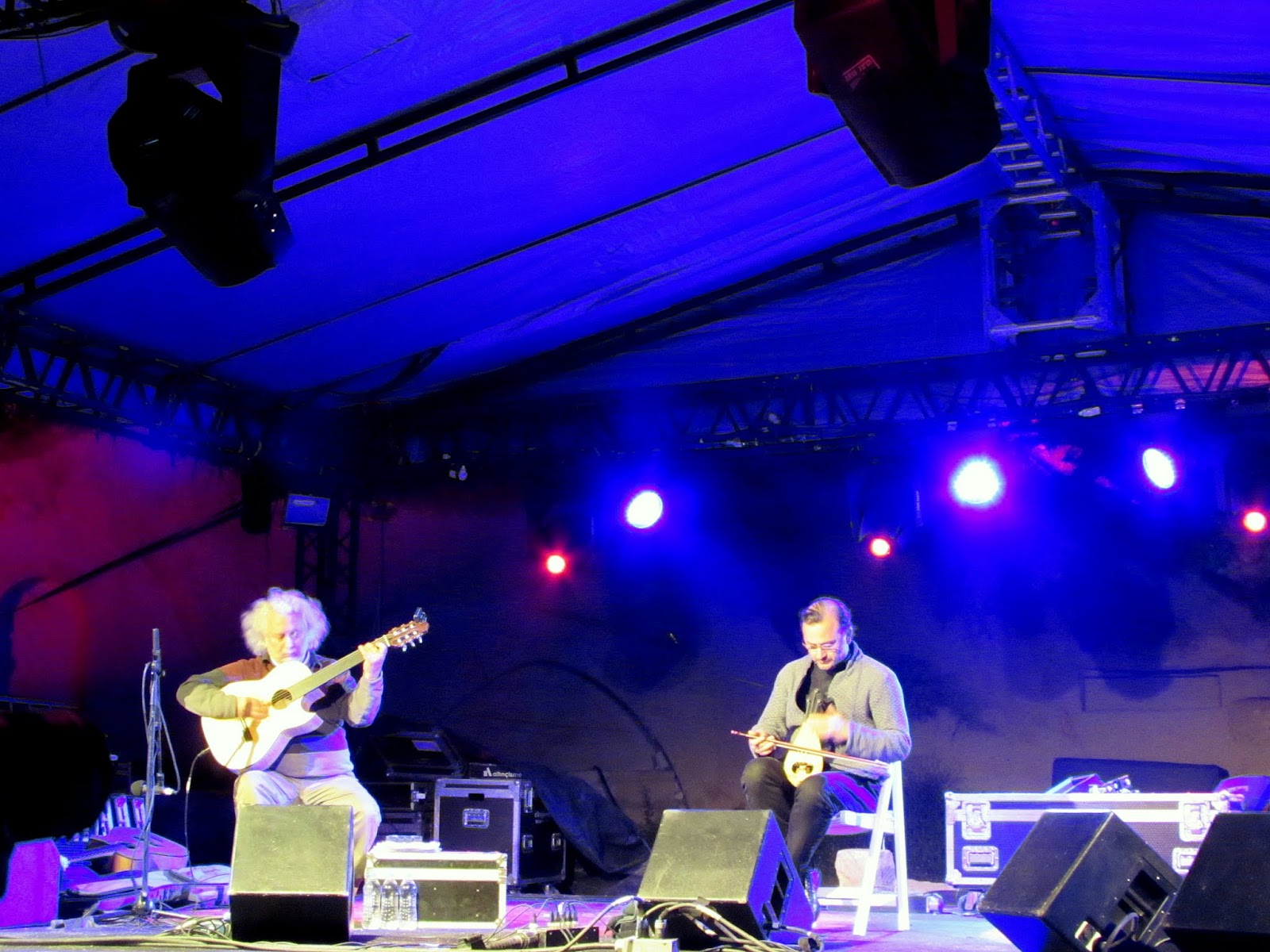

I had been told that Cappadocia was visually stunning, but it wasn't until I was met by a canyon of man-made caves and a veritable cave-castle from thousands of years ago that I understood why everyone was raving about the place. After passing Mount Erciyes and gentle empty rolling hills, the vivid canyon colors and rock formations come out of nowhere. Derya and Erkan's concert venue capitalized on the scenerythe stage was perched on the side of Uchisar Castle, which is basically a huge rock into which an entire fortress has been carved, and which overlooks a cave canyon. The best part is how hands-off the local tourism bureau apparently is. I didn't see any guides or rangers monitoring the area, and there are no barriers around the caves, and so while Derya and Erkan had their sound check, I trekked and scaled my way into the caves with my violin in tow (hoping to duplicate the cave sound experimenting I had done with my friend and flutist Agustian in Sumatra). Let me just tell you (and humor me while I wax poetic for a moment), there is nothing really quite like playing violin while perched in the ledge of a cave hundreds of feet off the ground and overlooking hundreds of miles of central Anatolian landscape, nothing quite like hearing your own sound bounce off and respond to the walls of a centuries-old Byzantine fortress. Derya and Erkan’s performance was fantastic (especially since the night of the concert, high winds threatened to topple the stage equipment off the side of the castle cliff).

Cappadocia photo interlude


See the person at the top of the fortress?


I had stopped in Madrid on my way to Istanbul to see my friend Rebecca (and mostly mope on her couch after leaving Bali); she more than reciprocated by cheerfully coming to hang out with me in Istanbul. It was great to see her; while I wasn’t completely emotionally settled with my change of locale, I was far less depressed than the last time I saw her and relished the chance to have a partner-in-crime with whom I could be a total tourist. We went to the Grand Bazaar one day, and giggled at the ludicrous tactics the salespeople use to get shoppers’ attention: “Hey sexy angel, let me show you how to spend your money!” I also received a marriage proposal from a salesman and the business card of a fur and leather merchant who asked if I would be interested in modeling for his clothing line. “We have many Russian customers. You would be good for this. You have face like baby.”
Marriage and fur modeling aside, I had recently made friends with Feyza, a Turkish student in my neighborhood studying environmental engineering, and invited her to join Rebecca and me as we went to see the sights. A note to would-be tourists: everyone and her grandmother wants to see the Hagia Sophia on the weekend—just don’t do it. The lines were Disney-World-meets-visa-line-at-the-U.S.-Consulate-in-China long, and yet we powered through, elbowing our way through the crowds at the dazzling harem at Topkapi Palace and the eerie Basilica Cistern. By the early evening, Rebecca and I were exhausted, but Feyza had a surprise for us:

“My friends have a boat, and they are fishing. We can eat dinner on the boat.”
At that moment, I was so tired, and the last thing I wanted to be doing was socializing with strangers trapped on a dinghy, but at Feyza’s insistence we made our way to the pier. Imagine our surprise to see a yacht waiting for us. Stunned, we greeted Feyza’s friend Acilay, a girl our age with perfect makeup and a dream of becoming a Turkish Airlines flight attendant one day, her middle-aged cousin, and his business partner. They offered us tea, blankets, and a delicious dinner of the fish they had just caught. Rebecca and I got a second wind, and just in time as Acilay turned to me—
“Feyza says you are a singer. Will you sing for us?”

I tried to explain that I was first and foremost a violinist, but at the urging of everyone on board, I sang two of my own songs. My performance was met enthusiastically, and soon everyone was sharing a song. It came out that Acilay is a talented belly dancer, and we begged her to demonstrate. She was fantastic, and she insisted we all get up and join her as the yacht continued sailing down the Bosphorus. 

All of the sudden, the music stopped—
“Now,” Acilay declared, “it is twerk time.” 
And indeed it was. Lest you think that was the end, I assure you we also had Black Sea dancing time and Balkan dancing time, and are looking forward to a reprise next week when Acilay graduates university.

Classic Istanbul sights photo interlude—prepare yourself for a lot of tiles


Blue Mosque
Palace rose garden


Hagia Sophia


Basilica Cistern

Blue Mosque
Despite how wonderful it was to explore Istanbul with Rebecca, as I frequently have over the course of this year I found myself once again plagued by doubts about my project. I worried that I wasn’t doing enough, and that the Istanbul iteration of my project wasn’t unfolding quickly enough. It had been useful to meet with Derya when he was available, as he took the time to break down and and explain the rules of makam in Turkish music. In such music, the makam determines the set of pitches from which a melody is derived as well as the rules for how it develops. One thing that is quite striking is that some pitches in the makam are not fixed, but flexible, changing position within a microtonal range depending on the direction of the phrase. For instance, in rast makam starting on D, the third degree if the phrase is ascending is more or less an F#; however, if it is descending, the pitch has glissando, sliding down from a pitch lower than F# but higher than F natural. And, if the phrase teeters around that third degree before descending, the first time it is close to F#, the second time it is slightly lower, but still higher than the third time, when it has the glissando to a lower pitch (still higher than F natural). You see?! It’s actually pretty intuitive in a way—the pitches of the melody conform to its shape.

Coming back from my tangent on Turkish music theory, Derya’s crash course on makams was useful to help me start to listen more critically; however, beyond talking about the music I knew I needed to play it if I wanted to internalize it. Luckily, promises of future music-making have started to arise. I reached out to Tolgahan Cogulu, a classical guitarist and professor at Istanbul Technical University’s Center for Advanced Music who has invented his own microtonal guitar with adjustable frets; he says he is happy to play makam-based music with me and is interested in arranging some pieces using alternative tuning systems from China and Indonesia for us to play together. Feyza’s friend Egesu is a guitarist and conservatory student who brought me to an experimental open music session—that’s where I met Sumru Ağıryürüyen, a prominent vocalist and conservatory professor who specializes in traditional and improvised music alike; she is interested in collaborating with me on a music project, and also went out of her way to connect me with Turkish violinists.

And so that is how I came to meet Baki Kemancı, a violinist whose name means “Baki the Violinist” (he was literally born for this). I had been baffled listening to recordings of Turkish violinists, as the timbre they achieve is so different that I would sometimes wonder whether they were even playing the same instrument as me. Balki gave me exactly what I had been searching for as he broke down and demonstrated the technique—a slow, womp-womp vibrato combined with precise patterns of sliding into pitches. The effect is relaxed and vocal, but very difficult for me because in many ways it is opposite everything I’ve learned from practicing Western classical music. I’m really excited—Balki is detail-oriented and has high standards as well as the high intensity I need to learn a lot in a short time. At the same time, he seems really friendly, and according to Feyza, he said, “You and I, although we don't speak the same language or come from the same music tradition, we understand each other’s music-making.” (Did I mention he doesn’t really speak English? Ah well, as usual I’m putting my faith in the language of music.)


It has felt slow going in these past weeks, and for the first time I am starting to feel pangs of readiness to be home. But, I have seen in this year how much can change and develop in just a few weeks, and I am optimistic that there is still time for my project to take a few more interesting turns before it’s all over. As always, I will keep you posted—
Minaret sunset

Monday, December 08, 2014

When cultural barriers become cultural barricades

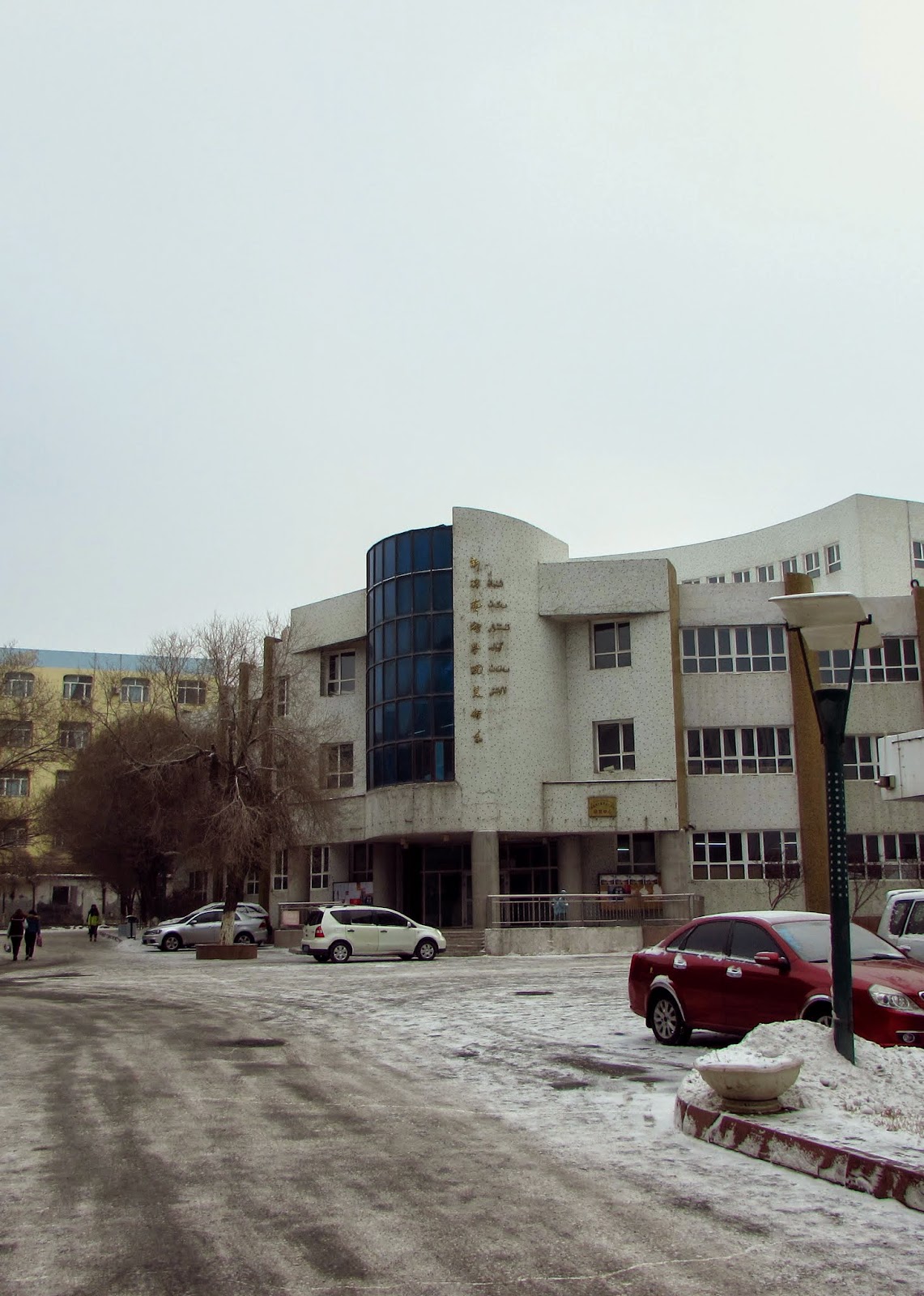
Snow on the ground at the Arts Institute
I left Urumqi about a month earlier than I had planned. It was a decision I grappled with for days. At first leaving felt premature, like I was giving up, like throwing in the towel because things got hard. Indeed, after the cushiness and glamour of life in Hong Kong, Urumqi was a stark contrast—gray dusty buildings against gray skies, freezing weather (coupled with a broken heater), a diet that consists primarily of starch and oily lamb dishes.


(Here's some listening for the rest of the post--first, a recording of a Uyghur music troupe touring in Urumqi; second, the Hami ghijak, a now-rarely played Uyghur instrument; and third, a muqam performance).

What struck me far beyond these superficial adjustments, however, was the unease that permeates the city and infects the populace. From my first day in Urumqi the divides that estrange the Han and Uyghur ethnic populations were tangible; for one, armed military police and tanks omnipresent at bus and train stations, shopping centers, mosques, and other major public areas were blatant reminders of past violence that has erupted as a result of tensions.

As a third-party observer, I was privy to the racism and xenophobia coming from both Hans and Uyghurs. I heard the rampant discrimination against Uyghurs, whether it was the Han taxi driver telling me that “Uyghurs are bad in the head,” implying that they have psychological predilection for being evil people, my Han acquaintances warning me that Uyghurs were backwards and to watch my belongings and guard my safety around Uyghurs, getting evicted from a predominantly Han nightclub for “dancing while Uyghur,” or hearing countless instances of police intimidation of Uyghurs, often arbitrarily through late-night “house calls.” Uyghur men are by default assumed to be terrorists, and are disallowed everything from the right to grow facial hair to privacy in their own homes in the name of counter-terrorism. Perhaps the most disturbing is what we don’t hear—the ongoing incidents outside of the city that don’t make the news, whispers and rumors of the clashes whose true catalysts and body counts we will likely never know.

Uyghur musicians lecture on muqam performance 
At the same time, it became increasingly clear that the Uyghurs around me were extremely disdainful of Han Chinese people, who they consider to be haram, or culturally and spiritually dirty (opposite of halal), because they are secular and eat pork. I found that Uyghurs tend to self-segregate, often only eating in restaurants run by Uyghurs (or at least Muslims) even when they travel to other cities. The Uyghurs I encountered didn’t consider themselves to have any Han friends (or even seem open to the possibility), and avoided speaking Mandarin except as necessary—even mocking the language among themselves. There’s even a term, mínkǎohàn (民考汉), that refers to Uyghurs who have studied at Han-run schools and speak Mandarin as their first language (sometimes better than, or instead of, Uyghur language)—they are often looked down upon by other Uyghurs, viewed as traitors to their own people, for selling out to their cultural oppressors.

It’s harder to fault the Uyghurs for this disdain—they are largely unwilling participants in the manipulation, and some argue diminution, of their own culture and customs. It’s not that Uyghur culture isn’t without flaws—for example, being a woman in Uyghur society is extremely oppressive in its own ways, including being valued based on one’s virginity, having to forfeit a career for a marriage (that almost inevitably will be marked by the husband’s marital dalliances), or hearing a lifetime of Uyghur idioms proclaiming the stupidity of the female sex. Beyond that, more conservative forms of Islam that prohibit music and dancing, for instance, are entering certain Uyghur communities in Xinjiang (much to the dismay of the musicians I spoke with).

Regardless, the current relationship between the Han and Uyghur populations, fraught with suspicion and mistrust, seems seriously flawed. “You could hardly find two more different groups of people,” a researcher told me. (This particular researcher speculates that at this rate Xinjiang could devolve into a Chechnya-like situation). I don’t think that the cultural differences between Hans and Uyghurs are actually the root of the problem; instead, I think that ignorant and rigid approaches toward multiculturalism (in particular an increasingly segregated education system) are supplanting efforts towards the mutual understanding that would lay the foundation for a success relationship.

It would be wrong to say that there is no future for Xinjiang Uyghurs musically; however, the traditional ways in which musicians have created music and thrived as artists certainly seem in jeopardy. Musical evolution that deviates from traditional modes of expression is a phenomenon arguably seen in all music cultures; the fact remains that artists will continue to be exposed to outside influences and new techniques and want to use them to create new, distinct modes of expression. In the case of Xinjiang, however, musical evolution is largely manipulated by overarching political motivations, and music does feel like it’s being used as a tool of mass distraction and pacification. To quote an earlier post:
This politically-informed gauge of what will be well-received, what’s appropriate, and what sends the “correct message” is shaping the Uyghur musical canon….It is degrading when an entire group of people is reduced to a few token songs and dances with funny hats.
Limitations on the content of songs and the size and number of Uyghur music concerts, as well as the dominance of state-sponsored platforms for musical performance (such as national “ethnic music” competitions and the annual nationally televised New Year’s Gala), artificially control the market for Uyghur music. (For instance, a Uyghur musician was severely punished for writing a song called “Mother Tongue,” which encouraged Uyghurs to learn their native language.) Illegal downloading of music de-incentivizes musicians from recording their work, and musicians scratch together a living working the wedding, club, and restaurant scene, which these days is hardly lucrative. Piracy and the difficulties of making it in the music industry are issues facing musicians in the States as well, the difference being that the government doesn’t control one’s ability to produce and consume music. Maybe one’s electro-grunge cyber-folk band that sings exclusively about promoting an agrarian society won’t gain traction with the mainstream public, but it won’t be because local officials are threatening the audience base or publishing dictates about permissible music tastes.

I write this post as a critical observer. I won't be so bold as to assert that I have clear-cut solutions (indeed, I would be skeptical of anyone claiming she did); however, I would argue that music doesn’t mask the unease in Xinjiang, but rather, upon close inspection, exposes the tensions pervading every aspect of society in the region. Perhaps the only suggestion I’ll make here is that in terms of the Han-Uyghur relationship, as with music, there should be a lot more listening and a lot less conducting.
A muqam ensemble

Sunday, November 23, 2014

The most beautiful green unibrow

A Uyghur woman in an Urumqi outdoor bazaar selling Osman grass in pencil, liquid, and raw form as a natural dark green makeup for eyebrows. Uyghur culture celebrates dark hair, dark eyes, and thick eyebrows, to the point that some women go so far as to draw in unibrows.

Friday, October 31, 2014

Heart-flutterings on Halloween

Happy Halloween from Urumqi! While we won't be getting trick-or-treaters, we have put up some decorations left by the last occupant of this apartment, who apparently had a penchant for theme parties and acquired a nice collection of masks and color-changing LED pumpkins. I accessorized one of the masks with a dopa, a traditional Uyghur hat, and made a DIY tampon ghost, so the place is officially tricked-out.

A photo posted by Audrey Woz (@audreywoz) on

A photo posted by Audrey Woz (@audreywoz) on

I've also been getting in the spirit by practicing Eugène Ysaÿe's "Obsession," the first movement of his second sonata for solo violin. Ysaÿe's series of solo violin sonatas was the Belgian violinist's response to the solo violin sonatas of J.S. Bach. This one in particular starts by quoting the light and joyful opening of Bach's E Major Sonata, and then quickly takes a dark turn, evolving into an exploration of the "Dies Irae" chant for the dead. I have a practice room on the Uyghur music floor of the Arts Institute, and so when I practice violin there the music coming out of my room stands in stark contrast to the Uyghur muqam coming out of the other practice rooms. Bach, and of course Ysaÿe, are unfamiliar sounds around here, and I have been struck by how excited people are to hear solo Bach--certainly more enthusiasm for Bach than I've ever encountered in the States! Whenever I practice Ysaÿe in the Arts Institute my ghijak teacher comes out of his office to listen; he told my housemate to tell me, "I love hearing Audrey play violin--when I hear her play violin my heart flutters!" (He made very sure she understood that it was my violin-playing he was in love with, not me.)


And if that didn't put you in the mood, here's Franz Liszt's even more blatant take on the "Dies Irae" tune:

Wednesday, October 29, 2014

BFF = Baijiu Friends Forever

Given that, in describing my entrance into Xinjiang, such terms as "traumatic" or "agonizing" or "consuming all truth and reason" would not be amiss, it seemed that as I finally got settled in Urumqi there was no way things wouldn't start going my way. But three weeks in, that's just it--I guess I assumed that once I arrived I would get my bearings and things would just fall into place immediately. In fact, every single day around here feels like an uphill battle, and an especially frustrating one at that because so much of the time I find I don't have a clue about what's going on (even when I thought I did)! Even the smallest tasks can require wading through many iterations of bureaucracy and procedure (not my natural proclivity, as you may know). Lest you think I'm just complaining about language barriers and culture shock--yes, there's some truth to that, but it's more than just that.
For instance: 
Instructions for enrolling in school as foreign language student 
1) Email school at address posted on official website
2) Wait for email to bounce
3) Track down current exchange student to give you email address of exchange program director, send message
4) Receive no response because "she doesn't check her email during the summer"
5) Get cell phone number of exchange program director
6) Call and explain that you would like to take classes, get vague directive to fill out application
7) Submit application and receive no confirmation
8) Show up months later at school, hope for the best

Even now that I am theoretically enrolled in the Arts Institute, I deal with a host of daily challenges. It took me nearly two weeks to get the correct card to check out a key to a practice room because no one in the Music Department seemed to know the correct procedure--professors would direct me to other professors, who would point me back to the original person I asked. For a few weeks my ghijak teacher was not responding to my inquiries about when we could meet for a first lesson--I thought he had dropped me as a student. Classes change meeting times sporadically, or are canceled without warning (at least for those who aren't connected via social media with the teacher). Xinjiang also operates on two timezones--the official time, which like the rest of China is calibrated to Beijing, and unofficial "Xinjiang time," which is two hours behind. This is a constant point of clarification that recently was only further convoluted by the school's take on daylight savings time--shaving off thirty minutes from class start times in two directions. My ATM card still hasn't arrived, although I discovered that it had been languishing in the Urumqi FedEx facility for a week and a half because they didn't have the right address on it. Even once I contacted them and they assured me that they would deliver it within a few days, it is nowhere to be found and I am no closer to paying my rent. In other words, even the things that seem like they should run like clockwork, well, don't. Even the clock! When my sister and I were little our mom used to give us these stickers of frogs wearing prize ribbons with sayings like, "I tried my best!" and "I solved my own problem!" I'm keeping morale up now by mentally awarding myself a frog ribbon daily.

Besides my frustration about how difficult it has been to get started in Urumqi, I also was feeling a bit blue about how codependent I am on my host. She's absolutely lovely and I am learning a lot from her about local music and culture, but the fact remains that she has her own life, work, and circle of friends that I can only encroach on so much. In addition to such trivial tasks as calling FedEx Urumqi and getting student ID photos taken, I set myself the goal last week to "make friends." Hong Kong was such a crutch--between the vast sea of English speakers and the easily accessible online events postings, I had no trouble connecting with new people. Not so in Urumqi--for one, there is virtually no English except among the few expats here*, and you're considered lucky to come across a non-belated concert poster. Beyond that, I just have had trouble finding opportunities to plug in with the community at the Arts Institute because it is so insular.
*A side note about the expat community in Urumqi--from what I have been told the expats here are  largely divided into two distinct camps: researchers and missionaries. While religion does underly many of the tensions in the region, I guess the missionaries are either discreet enough, or more likely considered a religious buffer against extremism by the government, to avoid notice. Still, they aren't discreet enough for the tastes of some here--my favorite anecdotes are the Uyghur who complained that the leaders of his English language circle "only want to talk about Jesus," and the missionaries in language classes who use biblical references in all of their example sentences. 
This downtrodden note seems like a great lead-in for what shall be hereinafter referred "The Great Uyghur Baijiu Bash of 2015." A little background: months before I departed for my Watson year, I came across this gem of a video--a Uyghur music rendition of Michael Jackson's "Billie Jean." 


It turns out that Abduwali, the musician himself, is an instructor in Urumqi, and the former teacher of a friend who just left the city. She had introduced us, and one evening I ran into him as I left the Arts Institute. We chatted and he invited me to come watch his ensemble's rehearsal, a Uyghur jazz combo-type affair. I eagerly agreed and watched them jam out until the bassist literally wore out his fingers. The musicians were great, and afterward some of them invited me to join them for dinner. We bonded over hotpot, one of them telling me about his Uzbekistan conservatory days and showing me videos of his award-winning performance in an international competition. They were excited to hear I was from Texas, and insisted they take me to Urumqi's aptly-named Texas Cafe after dinner ("It's owned by a Texan!" they exclaimed). Sadly, Texas Cafe was closed, but the night was just beginning. We went back to one of their homes, where they pulled out naan (Uyghur bread), a dutar (two-stringed lute) and a large bottle of baijiu, China's infamously pungent and potent alcohol of choice. After the musicians launched into singing muqam songs from Islamic poetry and Uyghur pop, they pulled out a shot glass. 
"Us Uyghurs, we like to make long toasts and tell stories when we drink." 
They filled up the glass. 
"We are so glad to have met you tonight. We are your friends for life, and if you ever need anything, ever, let us know and we will help you! Hosh!" 
They passed the shot glass to me.  
"Uh....um...it makes me so happy to have gotten to know you tonight and heard your wonderful music. Ours was truly a fortuitous meeting tonight. I am so grateful for your help and hope that I, too, can help you in the future! Hosh!
We toasted many things that evening ("To music!" "To friendship!" "Hosh!") and as we approached the end of the baijiu bottle, one of the musicians emptied it completely into the shot glass and handed it to me. I tried to politely refuse, but:
"This is me giving you my good luck! You cannot refuse!"
I figured that at least that would mean the baijiu consumption would be over. But then they pulled out a second bottle.

I just want to take this opportunity to clarify that until that evening, I had been drunk once in my life (one month prior) and had certainly never thrown up from drinking. In college, my exposure to extreme alcohol consumption was as the person keeping friends from choking on their own vomit. And so after I returned to my apartment that evening and slapped myself in the face to retain consciousness while throwing back liters of water, I had a chance for hazy introspection about the evening and where things had gone awry. My head was spinning and I was stumbling and slurring as I vocally coached my liver: "Hang in there--you can do this!" Barf. This is probably a sensation most of you have experienced long before I did last week; however, now that I have finally been naan-tossing drunk, I can confirm that the baijiu shots hellhole is one into which one should never descend, and that I have no intention of drinking to excess ever again. That said, I did feel a strong glimmer of pride as I stared into the toilet basin--I had gone to a Uyghur drinking party with fantastic musicians, held my own (at least in terms of speaking Chinese language), and left with self-proclaimed lifelong friends. Culturally speaking, this felt really significant because these types of get-togethers are a huge part of the social culture; moreover, as a female it was amazing to have had the chance to attend since gender divides are so strong in Uyghur culture.

As for less alcohol-soaked social gatherings, the girl who had introduced me to an erhu teacher at the Arts Institute has been very sweet and invited me to visit her family home in Shehezi, a town two hours away from Xinjiang. Her parents come from Gansu Province and speak Mandarin with a really strong accent, and so they would say something to me and she would translate it to more standard Mandarin. That said, we had some pretty eye-opening exchanges--for instance, they were amazed to hear that there are Chinese people in the United States who own Chinese restaurants where they make and sell dumplings. I gave her dad an English name, Mark, and then was at a loss when he immediately asked, "So what does it mean?" I looked it up and got "Mars" and "warlike," which I didn't tell him, so I settled for a happy medium: "It means you're fiercely awesome!" He seemed placated. Her family was welcoming to a fault, insisting that I sleep in their daughters' single bedroom while both of their daughters slept out on the couch. I felt bad (also stuffed because I had gorged myself on the aforementioned dumplings) but they wouldn't have it any other way. As for Shihezi itself, if you have the chance to go, I wouldn't--the city was constructed fifty years ago in the middle of the desert as a semi-colonial project. With massive streets, empty monolithic buildings, and a gentrified Han population it has all the charm of a waiting room. (Surprisingly it is home to a university of 40,000 students and participates in many international exchanges. Regardless, I can without a doubt say I have seen it, and helped you dodge a bullet in the process...)

I have had my first two ghijak lessons, and while it's still to early to offer any serious commentary on the learning process, it's a great time to post a new video of lackluster stringed instrument playing! Ghijak presents unique challenges from erhu, especially since it has four strings instead of two and the bow, which is not attached to the instrument, has a higher contact point with the string than it does on the erhu. My biggest challenge right now, beyond keeping the bow on the string, is keeping the bow on the right string--the whole instrument pivots on the spike that rests on one's lap, so there is a swiveling motion to account for when playing that I have never dealt with before. I really like my teacher, though. He's a really nice guy who is seriously picky and sounds like he is screaming all the time; in fact he just cares a lot and tends to talk loudly, especially about the history of Uyghur instruments and music. He showed me this very cool instrument which he called the "grandfather of the erhu"--it looks like a large erhu with a metal body and five sympathetic strings (not played but  that vibrate when the two main strings are played). Because of the sympathetic strings and the metal chamber the instrument echoes the notes long after they have been played, and the sound has a distant and haunting timbre not unlike a sitar. He complained that no one wants to study the instrument these days, and I told him I was very interested, so tentatively I am going to take lessons on both instruments! In the meantime, here's the video status report on ghijak and erhu:


I regret that there are not more pictures in this post--I haven't been toting my camera as freely because I don't want to draw attention to myself and also don't want to jeopardize anyone whose image I might post. That said, I'm working on it--more pictures to come!