Showing posts with label video. Show all posts

Wednesday, August 05, 2015

Let me tell you...

Final presentation delivered at Thomas J. Watson Fellowship Conference (University of Puget Sound, August 2, 2015).

Let me tell you who I was one year ago.

I'm a classically trained violinist. I've spent hours every day for the last fifteen years practicing major and minor scales and etudes as well as playing in orchestras and chamber music groups, all with the goal to make Mozart sound delightful and Beethoven dramatic. Everything I perform has been carefully rehearsed for hours to ensure bow direction and articulation is synchronized across whatever ensemble I'm playing with. I have been the concertmaster of the MIT Symphony for all four years of college, and now a soloist with the orchestra, so there's an added pressure and thrill to lead the group and perform with precision.

I'm Type-A, and so at the same time, I'm balancing my music major with my other political science-oriented major in East Asian Studies. I'm taking too many classes, trying to do well enough in macroeconomics and number theory to get Phi Beta Kappa and magna cum laude while publishing papers on the rights of overseas Filipino Workers and linguistic variation as a result of social media censorship in China. I have worked overseas for a media organization, and my longterm goal is to become an Asia-based foreign correspondent for a major news outlet. To this end I obsessively make to-do lists, plot my daily schedule in ten minute increments, and chronically, neurotically, strategize how I'm going to do well enough in my classes to ensure I achieve my goals in college so I can succeed at life.

It was at this point that I was selected to be a Watson Fellow. My college advisor, a faculty composer at Wellesley, was one of the first Watson Fellows years ago, and later the director of the Foundation, and from my first year at Wellesley he regularly suggested I consider applying. He is one of my closest confidantes, and so I took his advice to heart, after discussing potential project ideas, proposed a project around manifestations of musical multiculturalism, the subject of my senior thesis. Still, I had no idea what my day-to-day life on a Watson would look like, and having lived abroad before myself and also spoken to Watson Fellows who warned of chronic miserable loneliness, it would be an understatement to say I wasn't keen on the prospect of showing up in Indonesia, violin in hand, riding on the hope that I would find some way to fill my time.


Let me tell you about one chapter of my life on the Watson. Let me tell you about...Pak Sanglah.


He's a fifty year old man who is a literal guru, one of the few masters of Balinese rebab, an instrument made from a coconut that, with its loose tension strings and fluctuating pitch, sounds a little like a cat in pain--that is, if you can hear it over the throng of gongs, drums, flutes, and metallaphones that also make up the gamelan musical ensemble. Sanglah is the happiest person I've ever met, and likely ever will. We meet every day in his studio, which is open to the family temple and the chickens that run around it. It's also overrun with tokke lizards that live in the thatched roof and occasionally fall on the floor with a big splat. I stay there for at least three hours a day, but usually more like five, during which time he plays a slow, repetitive, tuneless melody that really doesn't sound so different from yesterday's. Nothing is written down, and I try to mimic his fingers until the patterns saturate my mind long enough to stick. We will play this forty-five second melody nonstop for thirty, forty-five minutes, before we take a short break. He is a man of constant smiles, gratuitous high-fives, and catchphrases. On the back of each of his two hundred business cards he has handwritten the words: "Success is good. Happy is better. If you want be happy, be happy now." Early on in our relationship he discovered I liked the fruit juice he made from the trees in his garden. He exclaimed, "Student likes juice, and teacher likes juice?! We are so blessed."

He believed so strongly in me, and gave me so much of his time and energy, and as I progressed in my lessons the intervals came more naturally and I started recognizing the signaling of melodic patterns, getting better at anticipating how a melody would develop based on its rhythms and internal phrases. At the same time, I am meeting other local and foreign musicians, who, as soon as they discover I am a violinist, invite me to jam, collaborate, perform with them. It is terrifying at first, because there is no structure, no notes written down, but I get in the habit of saying yes to everything, no matter how far-fetched it seems. Recording session for Kailash Kokopelli, Native American flute playing Swedish sound healer? Of course! Music festival with Hawaiian shamaness who is a self-proclaimed channel for Gaia the Divine Mother? Why not! Improvisation on Frank Sinatra's "Fly Me to the Moon" with a bunch of self-taught Balinese jazz musicians? Terrifying, but I'll try anything once. I make friends with a bunch of local Indonesian musicians, and we start playing nightly concerts all over the island--bars, cafes, art collectives, festivals...They have tremendous faith in themselves and the universe, and constantly tell me to stop worrying, that there's no rush. After a certain point, I stop being so worried about messing up the music, about sticking to some predetermined plan--and instead of feeling inhibited I start to be creative and have fun. I even start to write and improvise and perform my own music, using the musical traditions I have been learning up to that point--a totally foreign concept for this classically trained violinist, I'll remind you. People see me on the street and know me as "the violinist." It feels like instead of competition there is encouragement among this artistic community, and for the first time ever I have permission to get completely out of my comfort zone. 


I don't have time now to tell you about sleeping on the street during the Hong Kong pro-democracy protests, about going on tour with internationally-acclaimed cellist Yo-Yo Ma and the Silk Road Ensemble, cockfighting on Silent Day in Bali, learning Turkish classical and Roma and Black Sea music in Istanbul.

Instead, let me tell you about who I am now and what I've taken from this year.


The most obvious thing I've taken from this year was accomplishing my project. I set forth with the self-assigned, albeit abstract, mission to witness and learn about many ways multiculturalism can manifest itself in local musical traditions. In this last year, I've had the opportunity to play with hundreds of musicians and speak with hundreds more, perform many dozens of concerts in formal and informal venues alike, and been exposed and come to love and play musical instruments and styles I didn't even know existed a year ago. In that same vein, my definition of what makes music, and what makes a musician, has radically evolved from the definition I started with as a western classical musician a year ago.

At the same time, the pace of life I set for myself has been completely transformed as well. In the places I've lived in this last year I found so many people that make more time for one another, and give so much of themselves. If you meet someone for afternoon tea in Turkey, you'd best not make evening plans because you're probably going to be invited for dinner, and possibly breakfast the next day, too. I was constantly amazed by the generosity and patience my teachers, friends, and random strangers showed me in this year, and that's something I want to continue to emulate going forward.

Similarly, my Watson Fellowship project gave me permission to reach out to people for help and advice. It became easier and easier to meet new people and put myself in situations that risked embarrassment because I knew the potential reward of a meaningful relationship, or at least a story for my blog, would be worth it. I made incredible friends and had mind-blowing musical opportunities as a direct result of casting a wide net, taking a chance, and trying to reciprocate offers of help whenever I could. I could tell you a thousand stories about the unlikely circumstances that led to me befriending an onion farmer on a volcano or traveling to Anatolian caves with the Willie Nelson of Turkey, but I'll save those for another time, and plan to keep having more. 

The one thing I thought I would take from this year that still has yet to come is clarity about the future, where I go from here. I kind of thought that after a year of percolation, the answer about "where's this all going" would pop out right on time. Actually, after a year of meeting so many people from all over the world who approach life and music in vastly different ways, it seems I have less of an idea about what I'm doing with my life and skills than I did before. On the flip side, I'm more aware of the world of possibilities that are out there, and more assured that if I continue to be open to that world of possibilities I'll find a way to thrive in it.

What I do know for sure is that I am profoundly grateful for this opportunity, which has been truly and significantly transformational. Thank you, thank you, so much.

Wednesday, May 20, 2015

In memory of past lives and black socks

There has been a world of change on my end since my last quarterly report. I am writing from Istanbul, where I arrived a few days ago after passing through Madrid after flying from Bali to Paris. In short, it has been a whirlwind of culture shock--particularly upon arrival in Europe. I was despondent and mopey (to put it lightly) for days after leaving Bali. 


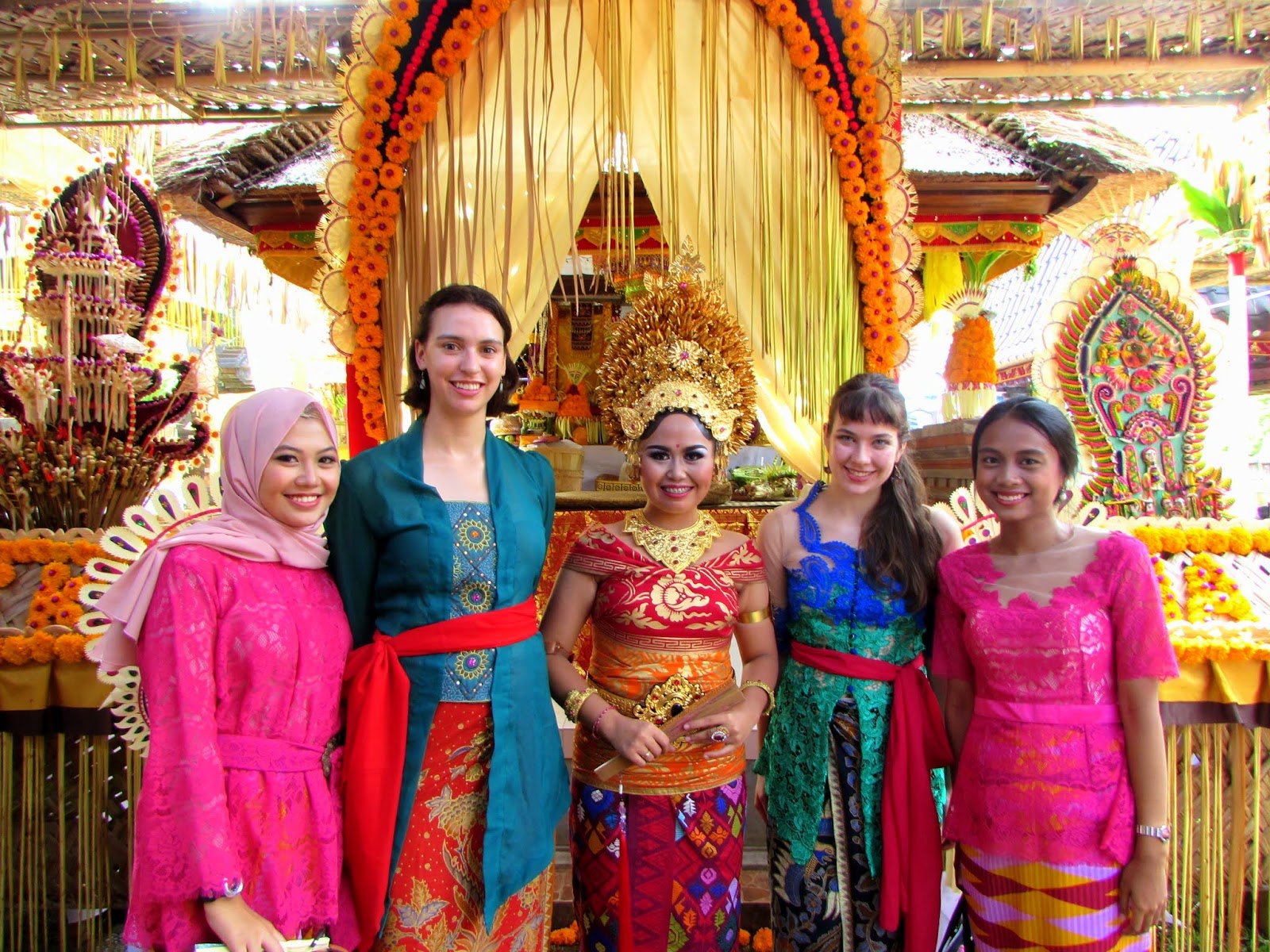
Nora and me with the bride and her friends at a Balinese wedding (where I played rebab)! 
Entry way to Balinese wedding


As I made more connections in Bali, 'jammed out' with more musicians, and was invited to play on more concerts, it seemed that I had hit a new musical stride in Bali and should ride it out. I basically said yes to every performance or collaboration invitation that came my way, and as a result, towards the last few months of my time in Indonesia, I was performing almost nightly in different venues (sometimes giving one performance on one side of the island and then biking to the other side to play another gig). I played with spiritual healers and reggae masters, I played rebab in a traditional Balinese wedding and also played in three shows in Bali Spirit, the island's largest annual music festival. Imagine hundreds of blissed-out, tattooed, dreadlocked hippies in one place peddling leather fanny packs and practicing their acro-yoga. After Bali Spirit one of the other performers came up and asked me if I had been using a distortion pedal--"It sounded like you were playing an electric guitar! It was awesome!" Another memorable comment from a different performance: "Audrey, I listen to you improvise and I am sure in your past life you were a Javanese person." (As said by a Javanese musician!)

A tangent about dreadlocked yogic hippies: In my various collaborations with Hindu chant leaders and Native American flute-toting medicine men, I had somehow carved out a niche for myself performing with sound healers. After a laughably pretentious recording session in which a medicine man repeatedly criticized me for not capturing the "essence of the night birds and rising dawn" in my musical "invocation of the divine through mystic poetry," I found myself at a dinner with many of his compatriots. It took me about half an hour of them talking about "the potency of the Grandfather" for me to grasp that they were talking about hallucinogens. Anyways, a Hawaiian shamaness and self-proclaimed channel of Gaia, the Mother Earth, heard about my violin playing and recruited me to perform with her at Bali Spirit. I eagerly agreed and showed up the following afternoon to her home. Picture a scantily-clad, heavily-tassled woman with a large lotus tattooed over her uterus playing crystal bowls, her emasculated partner Shamiracle, who could apparently do no right as she continued to scold him throughout the afternoon every time he hit a drum or blew a conch, a rhinestoned Russian with the plastic surgery of a former porn star who had recently changed her name in an Indian ceremony (and became increasingly annoyed as the other ensemble members continued to forget it), and Vasu Dev, a Norwegian with John Lennon glasses whose name belied how short his fuse was. And then there was me, wondering if I came off as way too normal to be part of the group, or if my musical journey through China and Indonesia qualified me as unorthodox enough to be one of them. In any case, they accepted me as one of their own. It was an interesting musical experience--on one hand, much of the spirituality with which the sound healers sought to imbue the music sort of cheapened it for me, but on the other hand, the lotus-tattooed singer had a beautiful and incredibly unique singing style that drew on overtones and yodels, and the freedom and presence with which she improvised was extremely effective.


Performing with Rizal at Bali Spirit Festival 


Being pulled into the spiritual undertow of Bali's expat scene was actually a really valuable experience for me as a musician. None of the sound healers I met had formal music training; as a result, it was really interesting to witness and experience their approach to creating music. Nothing was really off-limits (and in many cases, the more bizarre and experimental, the better) and for me it was a very safe environment to experiment musically as well. The result in some cases was music that would be considered really avant-garde in a different setting. In one show Agustian, Miyoshi, and percussionist Arif and I improvised a piece in nine (an unusual time meter) based on the theme of the change from the rainy to dry season while Sako, Arif's wife and talented dancer, did contemporary dance; however, catering to the Eat-Pray-Lovers, the concert was advertised simply as an "ethnic fusion" journey to "meditation," which again I think diminished how nuanced and multi-faceted the piece was.


Sako, me, Arif, Miyoshi, and Agustian after our concert
I even graduated to writing, singing, playing my own songs, which was one of the most thrilling experiences for me because it was something I had never dreamed of doing before. I was surrounded by people from so many cultures and backgrounds doing just that and playing in their concerts, and soon realized that there was nothing stopping me from doing the same. I would brainstorm, create, and record a rough draft of a new song, and then show it to my friends, who would add their own instruments and musical ideas to it. They encouraged me to perform my own songs (and made time in their own shows for me to do so). I was initially really nervous since it was entirely new to me, but I went for it and received really great responses. I was so encouraged when an audience member came up to me and said, "You have an amazing voice--be proud of it and stand tall!"

Another huge highlight towards the end of my time in Bali was having my friend Nora visit me. Nora is traveling around the world on a traveling fellowship of her own exploring cultures that eat bugs, and sent me a message that she was thinking of popping over to Bali for a week or so on her way out from a month in Papua New Guinea. She asked if she could crash with me, and I, valuing my personal space but unwilling to tell her to "get a room," begrudgingly offered to host her. We ended up having a phenomenal time, and at my urging she stayed for the better part of a month. She has been traveling independently at the same time as me doing entirely different things, and it was incredible to hear about her experiences and compare successes and failures. She is one of the few people I have encountered thus far who can understand what it's like to make connections while transient, pursue an esoteric project in a foreign place, and watch the holes in your underwear get bigger and bigger. (One of my greatest triumphs was dragging Nora to replace her pants after a bumpy motorbike ride made it clear that the purple patches holding them together were no match for the life of a traveling fellow.) We sought out dragonflies for her to eat and introduced her to wandering hippies as "Peekaboo Nevernude, owner of Tissle-Tassle, a tassled clothing boutique" ("But my friends call me Boo!") It was great having her--as a traveling fellow, she is totally used to being independent and would set out for solo adventures while I would have rehearsals; at the same time, we totally related to one another and there were no limits on the fun we would poke at the mishaps we had had over the course of our travels.

Speaking of entertaining mishaps, Nora joined me and my friend Agustian to travel to his village in Sumatra for his sister's wedding blessing ceremony. As soon as we arrived, I was so grateful she was there--his relatives and neighbors overwhelmed us with hospitality and requests to take photos, and as the token foreigners in a village where few will encounter outsiders we were shuttled all day from one house to the next for photo ops while people continued to ask if (or assume) we were Agustian's fourth and fifth wives. I soon got really exasperated--I generally reject people who ask to take my photo on account of my being white, but it was impossible to do that to Agustian's family and friends, all of whom seemed to each have a few phones that each needed at least four photos...We stopped at three hospitals and took photos with all of the nurses and midwives, we stopped at the home of the village elder and took photos with village representatives there, we even stopped at a police checkpoint and, instead of paying a bribe, took a photo with the police. (We were later featured in the regional news.) Nora remained a good sport throughout, and when we were brought to Agustian's friend's family home late at night after a long day of posing and confronted the family waiting for us with karaoke, she took the microphone and sang campfire favorite "Black Socks" in the style of Indonesian dangdut music. What a champ.

Black Socks (lyrics)
Black socks
They never get dirty
The longer you wear them
The blacker they get 
Sometimes
I think I should wash them
But something inside me
Keeps telling me,
"No, not yet, not yet, not yet..."
One high point of the trip was journeying out to Gua Putri, a legendary Sumatran cave outside of Lampung. The myth goes that a princess was taking a bath when a man passed by and catcalled her. When she didn't respond to his comments (big surprise) he commented that, to ignore his flattering words, she must be made of stone--and lo and behold, she turned into stone, becoming the Gua Putri cave. This is a mythological manifestation of kutukan, sort of like the power of suggestion or the power of the word (for negative results). Anyways, sort of channeling fantastic musician Andrew Bird's recent project, Echolocations, in which he makes recordings in unusual settings (most recently, the canyons of Utah), Agustian and I brought the bamboo flutes and violin into Gua Putri, sought out the most resonant spaces, and had some fun improvising (I also played some Bach--typical.)


The loveliest-sounding part of Gua Putri 


Men in Indonesia often collect gemstones, carry them around and/or turn them into rings,
and show them off at every opportunity


After our short jaunt in Sumatra, Nora and I spent a few days in Jakarta while Agustian visited his other sister, and then parted ways as she set off to Laos and I returned for my final week in Bali. Feeling that I had become inspired, but also perhaps too comfortable, in Bali, I impulsively bought tickets to Madrid, deciding to visit my longtime best friend Rebecca on her Fulbright before making my way to Istanbul. 

The reality of my decision started to set in a few days before my departure. Perhaps you can imagine how difficult it was to leave such an environment. People would see me on the street and know me as "the violinist," and when I would go out, I would always see people I knew. I was conversational in Indonesian language--not enough to be particularly interesting to talk with, but enough to venture off aimlessly on my motorbike, get lost, barter for something, explain my purpose in Bali, get invited to someone's village, know when I was being talked about, and get back again. Indonesia was an incredible incubator for creativity, one that fostered collaboration over competition, and a place where people were constantly encouraging one another to feel more, love more, create more without any rush or deadline to do so. For me, a chronically-busy and uptight classical musician, it was exactly the shot in the arm I needed (I remember being too terrified to try to improvise when I first arrived four months ago!), and leaving it I became so scared that I wouldn't bring that spirit of creativity and non-urgency with me--that I would be too scared or too uninspired to carry on without those people who supported and taught me.

My friend Mark, who I met on my first night in Ubud, invited me to play at his collective's open mic night the following day, and essentially triggered and supported my period of musical creativity in Indonesia, hosted a farewell party for me the night before I left Bali. It was tremendous to see everyone from different arenas of my life on the island come together, meet each other, and make music. My rebab teacher met a local artist and flute player, my fellow Seven Sisters graduates met Lanny and her family, who had hosted me when I first arrived in Bali, Soraya (my partner in crime for the last Terunyan trip) met Miyoshi (my partner in music-making). People who I had played music with and played music for all came out, and it was an amazing testament that in some small way, I had joined a community and made a network. The only one who didn't come was Agustian, who was apparently too sad to come. ("Someone stepped on my flute. G#. It's broken now. And I thought it would be too sad for me to be there.") 
Farewell party jam session
I wept my way to Madrid, and spent the following days sitting shiva for my time in Bali. I had arrived in Madrid and reunited with Rebecca, who was in her chemistry lab during the weekdays, leaving me with nothing but time to mourn leaving my friends, my motorbike, my inspiration. Beyond missing the people I had left behind, I was terrified that "you can't take it with you"; namely, that I was losing the permission I had received in Bali to take risks, try new things as a musician, and think outside the box. I was utterly unable to do anything; my schedule consisted of waking up, weeping to Sufjan Steven's album "Carrie and Lowell," inspired by the loss of his mother to cancer, listening to the rough recordings from jamming out with my friends in Bali, crooning softly to myself, and repeating. Poor Rebecca, who had probably expected a more festive reunion, was a great sport about striking a balance between watching me sob and dragging me out of her tiny apartment. We did have a great time, all things considered (and I'll make it up to her when she comes to visit me in Istanbul in a few days); she took me to see a Steve Reich concert and violinist Joshua Bell's performance with the National Orchestra, we had tapas and paella, and saw as much as we could see in one day at the Prado.


I was indeed in a period of mourning, but now that I have arrived in Istanbul and gotten a glimpse of the sheer abundance of culture that seems to be oozing out of the city, I am encouraged that in a way things here will be "same-same but different," as they say in Indonesia. I have connected with a kamence player who is eager to take me on as his student, let me shadow his rehearsals and work at Turkish National Radio, performed my first concert, befriended a national living legend/inventor of the fretless guitar, and am on the cusp of meeting many more musicians (as soon as I can send off some emails). It's really hard starting over, especially since everything feels unfamiliar and foreign again, but at the same time I have faith that leaving Bali to get a new perspective in Turkey will be worthwhile and fulfilling. It has been already--more to come soon!

Illustration of me playing violin by my dear friend Miyoshi

Saturday, February 21, 2015

Improvised homecoming


I made the most of my assumed final days in Bali, adventuring on back roads, some last downward-facing dogs in yoga class, getting together with the dear friends I had made, and having a really lovely and sentimental lesson with my rebab teacher. Our relationship had gotten much better since my last post, in which I complained about him taking way too many pictures of me—after I told him I didn’t want him to take pictures and was very cold and distant towards him in lessons, I think he got the message. The picture-taking was certainly not from a place of maliciousness or creepiness on his part (although the feeling was uncomfortable nonetheless).

In any case, we had reached a much better point, and on top of that I was finding that despite my initial antipathy for, or even resentment towards, the music I was learning, it was truly growing on me. In the first few weeks of studying rebab, I had found it difficult and tedious to loop the repetitive melodies for hours on end. I was also frustrated trying to wrap my mind around the tuning systems, which to my ear sounded chronically out of tune. Still, as I progressed in my lessons the intervals came more naturally and I started recognizing the signaling of melodic patterns, getting better at anticipating how a melody would develop based on its rhythms and internal phrases (here's a sampling of what we do in lessons, but for about three hours).

Still, when the beginning of February came, it seemed like it was time to leave Bali. While I was getting a real grasp on rebab and starting to hear Balinese music in new ways, my visa was set to expire at the end of the month and I was eager to get a change of perspective before then in Banyuwangi, at the eastern tip of the island of Java. While I had made some lovely friends in Bali, they were not Balinese, but rather travelers passing through or expats. Leaving for Banyuwangi thus felt like an exciting chance to get a different and potentially more 'connected' experience musically and culturally. 

[interlude for a lifetime's supply of rice field photos]


That's me on the bike, everyone!
Volcanoes in the distance


Balinese temple complex


Banyuwangi sits opposite Bali across a small strait—the ferry ride takes only an hour, but in the words of Evan Ziporyn, it’s amazing what a huge cultural difference a small body of water can make. Bali is predominantly Hindu, while like most of Indonesia, Banyuwangi is predominantly Muslim—both are obvious by the proliferation of temples and mosques, respectively. In Banyuwangi religion is particularly prominent in everyday life, from the veils worn by many of the women to calls to prayer blasting at full volume from what sounded like scratchy megaphones regularly throughout the day. The town is working on boosting its tourism inflows, but it feels hotter, dustier, and poorer than Bali.

[another brief photo interlude]
Bus ride with a view
These rapscallions were diving in the water by the ferries for money  
Even from afar Banyuwangi seems a mystical place
Bye-bye Bali

Java on the left, Bali on the right
The music in Banyuwangi, as expected, is totally fascinating—on my second evening there, I attended a kuntulan ensemble rehearsal consisting of many drummers, gamelan elements, triangles, synth keyboard (obviously not a traditional element), and female singer. The drumming patterns are incredibly complex, and the synth keyboard’s melody used the pentatonic pelog scale intervals I had been learning in Bali. Traditional music ensembles in Banyuwangi are unique for their use of violin, or biola. One such ensemble is the gandrung music ensemble—gandrung, one of the genres of traditional music in Banyuwangi, is derived from a tradition called seblang, in which (as I understand it) a female singer dances with many men while singing in a sort of trance for an entire night (about midnight to 6 am or so). 
Nighttime kuntulan rehearsal
I met a woman who makes Banyuwangi dance costumes for children's dolls out of trash

I took lessons on the biola, aka violin tuned nearly a fifth lower than normal, played at mid chest level, and pivoted using the left wrist (rather than changing the level of the bow). The music is notated using a numbered scale degree system (as in China); this is especially convenient because the notation doesn’t change regardless of what set of gamelan instruments the player is tuning to. I was amazed to hear my teacher play a piece using the scale degrees in a diatonic major scale, and then play the same piece using pelog tuning. I had also heard that Banyuwangi music draws on Balinese, Portuguese, and Malay influences. Indeed, it was fascinating to hear the cyclical repetitions based on a gong that permeated the songs, yet a strong emphasis on beats 1 and 3 within melodic phrases that doesn’t appear in Balinese music. Biola players also do a lot of improvisation, ‘fiddling’ in a much more active way than the rebab does in Balinese music. In general, the melodies sound more “melodic” and tuneful than they did in Bali; when I played them for some non-Banyuwangi musician friends in Indonesia, they commented they sounded like they were from China. Although the left hand pivoting technique was a bit tricky, the melodies were much easier to pick up and retain than those in Bali, and the improvisational patterns were pretty straightforward as well, oscillating in dips around a core note using the notes in the pentatonic scales.


My hosts in Banyuwangi, the niece from a local family of dancers and her husband, were overwhelmingly hospitable. They made hosting me their top priority, and shuttled me around to meet cultural bureaucrats and potential music teachers and to attend music ensemble rehearsals. The level of concern they showed as hosts was truly unprecedented, and actually took me by surprise; after registering me with the police, who told him “don’t let this beautiful girl go places by herself,” the husband of the family took that advice to heart and accompanied me everywhere short of the bathroom. His wife, concerned I couldn’t stomach outside food, insisted I could only eat food her mother prepared for me. Going outside for a walk or to get basic items was not a possibility, and every outing was arranged for me and chaperoned. Although I asked about finding different outlets for getting out of the house and making some friends on my own (for instance, leading a language exchange at a local college) it was a dead end; my days were a music lesson in the morning, and then, at the insistence of the family, “taking a rest” that lasted the rest of the day. I tried to make an effort to talk with the family and help with making meals, but they wouldn’t let me engage. I understood this was their way of regarding an esteemed guest and in their minds was for my benefit. I also acknowledged that in Banyuwangi, where English levels are significantly lower than they are in Bali, and the culture is in some ways more mysterious and closed (especially to female foreigners), I needed the foundation of a host family; however, I felt like remaining in that environment of mandatory dependency would make it impossible for me to develop my own relationships, make my own mistakes, and find the spontaneous opportunities that have been the highlights of my Watson year.

Sitting in my room in Banyuwangi for about ten hours a day, I got a little stir-crazy and pined for the independence I had in Bali. I spent two days crying about missing my hyper-positive rebab teacher, actually—while it was possibly a bit of Stockholm syndrome since it was physically hard, a lot of mental work, and a bit bizarre to deal with his quirks, I realized that I really loved learning from him and was really getting to enjoy the music (and life lessons—did you know that the grass and the carrot are our teachers?) he taught me. I chronically read the old texts he had sent me—here's an excerpt:
Audrey good morning. How are you? I am super good. Thank you for your letter to me. I am very glad share with you music and life. I would like to tell you more, but I have problem in my English. I hope you understand. Remember. Long life learning. Learning is never ending. Every thing is teacher. Lets learn from every thing. I really hope see you again. I hope you healthy and happy always. If you happy and smileing, the world be happy. Ha Ha Ha (hope always, health always, happy always). Have a nice day. Thank you/suksma.
My rebab teacher and me
While the music and culture in Banyuwangi seemed absolutely fascinating, I felt paralyzed by the hospitality of my incredibly kind and generous host family, who was, after all, just looking out for my best interests. After much pondering (as it was all there was to do in my daily, all-day “resting time”) I made the decision to return to Bali for my last few weeks before my visa ran out. I worried that I was just clinging onto what felt comfortable and quitting when things got hard—but in fact there just seemed to be no chance to forge my own relationships and connect with the culture given my short time, lack of Indonesian language skills, and general outsider/VIP guest status. I decided it was best to come back to Bali for the last few weeks, reunite with my rebab teacher, go to as many Hindu ceremonies (to hear Balinese gamelan) as possible, continue learning Indian devotional mantras from my friend, explore and ideally meet some interesting people before moving on.

After I told my host family I was returning to Bali as tactfully as I could and survived the non-air conditioned, hurtling, smoke-filled bus back to Bali, meeting interesting people happened much sooner than I expected. (My rebab teacher also called me: "Welcome home! I missed seeing you for lunch or dinner. Come back, we will share your experience, my experience.") My friend and fellow Wellesley alum Carly invited me to join her to watch an open mic night the day after I returned. By chance I met, and ended up jamming with, a group of really awesome young Indonesian musicians—some of whom I had heard about but not had a chance to meet before. Without thinking, I found myself improvising using the scale systems I had been learning for six months—and surprisingly, not stressed out but actually enjoying the music (even though I had no idea what was coming). One of the musicians, a percussionist and aspiring ethnomusicologist from Java, marveled that I, a Western musician, was improvising using the scales from gamelan tunings with ease. “Let’s play together again soon!” he said. “How about tomorrow?”

So the next day, we went to Agustian’s studio. I already was acquainted with Agustian, amazing artist/sculptor/sewer/dancer/musician, because he plays with the Indian musician whose meditation classes I had been performing in. Agustian had been inviting me to his studio for weeks, but I had not visited before I left for Banyuwangi. I finally understood what the big deal waswhen I entered the space—it’s a beautiful, airy place that serves as gallery, collaborative workshop, and hangout spot for him and his friends. The first week I was back I spent hours every day there meeting new musicians and jamming out with them. A totally foreign concept for this classically trained violinist—following your instinct/curiosity in the moment? And yet, with this group (and in Bali generally), it feels like instead of competition there is encouragement among the artistic community. It’s an extremely supportive and collaborative environment, aided by the fact that members of the community here are only ever a few degrees of separation apart.

Anyways, on one such afternoon of stringing together improvisations based on pentatonic scales accompanied by eager banging of djembes and tooting of Sumatran flutes, I met Rizal, a Javanese singer/songwriter who just came to Bali after months of touring in Australia. He writes really beautiful music, and is a particularly memorable performer because he plays instruments he made himself, most notably a bamboo didgeridoo/guitar combination. That day, I was toting my erhu, and so he, Agustian (on handmade flute), and I had a blast playing together. Even though I am a bit out of practice on my Chinese fiddling, Rizal still seemed impressed: “We should make more music together!”

We got together a few days later to continue our music-making—hours later, we were still talking away about music and sharing some of our favorite artists. Between hearing about his social activist days cutting class to lead protests around Indonesia and his approach to making music now that he is first and foremost a traveling musician, it has been absolutely inspiring to be around Rizal. He is someone with the ability to both envision and execute—he dreams big and assumes there are ways to achieve those dreams, from inventing his own instruments to arriving penniless in Australia with only his instruments and the belief that he could survive on his music-making abilities.


Rizal was telling me about his booked schedule of upcoming concerts in Bali when he asked, “Why don’t you make a visa run to Singapore and come play them with me? And then we can record an album together!” The effortlessness with which he tossed out the question belied the outlandishness of its requisite spontaneity—that morning I had had a promising discussion with a master musician in Istanbul about working with him, and was set to purchase tickets to Turkey departing when my visa expired in ten days. Rizal’s invitation was alarmingly casual in its extension, but it became increasingly clear that this wasn’t a flippant offer—he was entirely serious, extending his invitation thusly because it seemed like a real, exciting prospect.

The idea rolled around in my mind for the nights to come. I had loved playing music in this new and unplanned way, while calling on everything I had picked up from the hundreds of musicians I have heard and met in the last sixth months. At the same time, it is scary to feel out of my element—the music I have grown up playing is written down, practiced for hours and years, and delivered to the audience in a deliberate and premeditated way. And playing live shows and recording an album? Featuring ‘pop’ music (by my musical standards)? Terrifying. I also felt the pressure to not succumb to traveler’s inertia—I theoretically have four more countries to go to in the next five months, and that’s barely enough time to scratch the surface of any music culture.


Still, even though Rizal’s suggestion had seemed an impossibility at its utterance, it continued to incubate in my mind. Wasn’t this—learning from and collaborating with musicians who are drawing upon their own musical cultures as well as ‘outside’ influences, plus getting out of my comfort zone while utilizing my experiences and channeling my passion–exactly the goal of my Watson project? And logistically speaking, my plans are still entirely flexible, Istanbul is not going anywhere, and popping over to Singapore and back for a new visa is extremely feasible.

So as of now, I have a roundtrip ticket to Singapore, a tour of Bali's live music venues lined up, and some extremely exciting musical prospects on the horizon which I will write about soon. In the meantime, my first concert with Rizal and the newly incarnated "Ubud String Collective" is tomorrow night—video and a full report to come!

[And now, some final photos from my recent Bali nights—]

I was driving on the Ubud main road at midnight when I heard gamelan--
lo and behold there was a huge dance performance (not geared towards tourists) going on!

Ceremony at Balinese temple
Middle schoolers gamelan and dance performance