Showing posts with label tradition. Show all posts

Thursday, July 23, 2015

Up in the air / homecoming


I am forty thousand feet above the ground and have four hours before I am back home for the first time in 372 days. I don't know if I have the words now to describe what that feels like. I feel depleted, heartbroken, grateful, unprepared, ready, excited, bewildered, and most of all, exhausted as this enormous jet soars somewhere over the Quebec airspace. It's impossible to process the last weeks of this experience, much less the year in whole and the impact it will have on my life as I go forward (and what going forward even looks like). I will save that processing for after I get a full night of sleep (or a few). For now, I think back on my last month in Istanbul.

I never completely found my footing in Istanbul. I continue to be struck by how massively sprawling and diverse the city and its culture is. It was always foolish to think that I would be able to get a handle on the musical traditions of the city in a few short months, but as the end of my fellowship approached and I encountered more and more musicians, I grasped that it would take multiple lifetimes to truly absorb the breadth and depth of musical cultures and traditions in Turkey. In my first month and a half in Istanbul, I focused on studying Turkish classical music, which in and of itself has a rich, centuries-old tradition that requires thorough understanding of hundreds of makams--to play Turkish classical songs, you have to be knowledgeable about the set of pitches in the song and how they behave depending on the melodic direction, as well as proper ornamentation and articulation conventionsand if you want to improvise in this style, you have to know all of these things so innately that you can create new expression within the existing musical framework. It's a fine balance that requires a lot of skillhave enough knowledge of the rules and existing repertoire as well as ability to perform them so that you can use them, tweak them, and break them in an intelligent and evocative way that is relevant to the tradition and communicates with the audience.

It was this musical tradition that I was broaching with my primary hocas (teachers), Necati Çelik (oud player) and Baki Kemancı (violinist). Every day I met with Necati, he would give me two pieces in a new makam/scale system to learn, and we would play them together a few times as other students, friends, and musicians would stream in and out of his office to talk and just listen. It was fascinating to work with Necati, who is simultaneously a very warm and generous person and also a traditionalist rooted in a personal mission to preserve and spread Turkish classical music as well as older traditional Turkish values as well. It was frequently frustrating to work with him because although I know he respected me as a musician, he could be very critical, impatient, and a bit patronizing (though never in a mean-spirited way). I came to realize that a lot of what he says probably just doesn't translate well, and from that point on I was more amused and offended when he would exclaim, "Why do you keep making the same mistakes?" I remember him taking my face in his hands one afternoon: "Audrey, I love you. You know nothing." Still, it was clear that he was hard on me because he was impressed with my playing and believed in my potential. During Ramadan, the thirty day Muslim holiday that requires observers to fast while sun is up, Necati invited me to his iftar dinner (a literal break-fast) for his friends and family. After the dinner, held at a fabulous mansion that used to be a meeting place for teachers, in front of everyone he invited me up to play classical music with him. It was a huge honor, as over sixty of his students, friends, and family members were present and I was the only one (besides his son) he invited to play with him.


Performing with Necati hocam at iftar


At the same time, I was working with Baki, who is renowned as a violinist for his skill and flexibility as a musicianhe is an excellent player of Turkish classical music, but he can also perform many other (more popular) styles, including Roma, jazz, Indian, Irish folk...His family is Roma, and when I told him I wanted to learn some songs from that tradition our lessons got flashier and flashier. He started writing out belly dance tunes in complicated (for me) time signatures (five beats, nine beats, etc.) that we would play at gradually quickening tempos, all the while adding showy embellishments. We would play a piece faster and faster until it was a whirlwind that would get even the most stoic listener to start tapping his toes...except for Necati. When I made the grave mistake of showing him some of the tunes I was learning with Baki, it was as if I had insulted his very essence. "Sevgili [dear] Audrey, you have been playing music for so long, have been studying violin for such a long time, I don't understand why you are learning this. You are wasting your talent. You have forgotten everything I have taught you. You are too good for this music." He went on: "Next time you come I hope you will be just my student. You are studying with many people and it is making you confused." I quickly tried to save things by assuring him that most of what I was working on with Baki was Turkish classical music, but still it felt like I had made a gross misstep. It's not just Necati from whom I have heard this sentimentmost of the Turkish classical music purists I have met assert that the style sits at the top of the Turkish musical pyramid, even going so far to deem other, more popular and colloquial styles, such as Roma and Arabesque, not music at all. As someone who was experiencing many Turkish music styles for the first time and learning to differentiate between them at the same time, it's hard for me to understand why such musicians can't tolerate these other musical styles. It's one thing to not like a different style, but to dismiss it and its creators entirely because it's too low-brow? 

I was learning some Roma music with Baki, and also met Oktay Üst, a musician with the muscles and thick well-groomed mustache of a reformed pirate who was part of the well-known Black Sea music ensemble Karmate. He now runs a cafe-cum-instrument workshop where he and his friends play music outside on the street daily. I was at the cafe with Egesu marveling at Oktay's incredible command over the kemençe, an instrument with a simple appearance he was using to crank out the most elaborate melodies and rhythms at lightening speed. At Egesu's urging, as I was fairly nervous to approach the guy, I went up to introduce myself and ask if he would be willing to show me some Black Sea music. "Come anytimewe are always here." I went a few nights and did my best to keep up with Oktayuntil I insisted he slow down and sing the basic melodies of what he was playing, I could barely pick up the tune. Beyond the complex rhythms and even more dense ornaments that render simple melodies in perpetual motion, it didn't help that the kemençe is tuned in fourths, rather than fifths like the violin. (After I retuned my violin to match him things got a lot more entertaining.) While I definitely have so much to learn in Turkish classical music, I wish I had spent more time, or just had longer, to focus on Roma and Black Sea traditional music styles, which are radically different (and more energetic and engaging in many ways).


I wrote last time about having a fantastic time going to concerts and events with Egesu, an electric guitarist and music conservatory student. Spending time with him has been one of the great, if not greatest, highlights of this year. As we spent more time together, it felt like I had met someone I had already known for years. In my last month in Istanbul we went to countless astounding concerts, went hiking and swimming with non-stinging jellyfish on the island of Büyükada, got cheesy temporary tattoos of each other's name, cooked at home and went for midnight coffee, met his friends and mine, tried out what seemed like every breakfast place in my neighborhood, argued about capitalism and John Cage and Mozart...Saying goodbye was heartbreaking, but it's not farewell, as we are already making plans to reconvene in the months to come. 

For Egesu 
Thank you, thank you, for sharing the time we had with meafter everything in this year, I look back on our time as my fondest memories. The concerts we saw, the fortunes we told in coffee cups, the evenings we sat by the sea, the cooking and dances we attempted, the songs we made up...these memories are precious and I treasure them. You put me at ease, make me laugh until I think I'm going to explode, make me feel alive and excited, and every time I see you I am profoundly grateful. I am waiting for that bright day, not too far from now, when we'll meet again.


There's now a little over an hour and a half left before my homecoming. It's going to be a shock, I know. I stopped over in London last night before taking my flight today and was struck that I could comprehend the conversations happening around me for the first time in many, many months. What a luxury! At the same time, as I said before I feel drained by this constant state of flux I have been in for the last week (and perhaps the last year). Especially recently, there have been moments where I'll see something random that triggers my mind and I have a visceral flashback to a completely different placefor instance, something on the street in Istanbul will mentally transport me back to Bali. At times I can feel the presence and impact of the teachers and friends from each place where I have spent time this year, and perceiving that connection is a sensation both incredible and overwhelming. Remembering huddling under blankets in my dreary room in Western China one moment and then thinking of the long hot days spent in the studio of my rebab guru in Bali the next is almost too much to bear or comprehend. It feels like I've been in completely different worlds and lived completely different lives--and to a large extent that's true. Some of my "lives," or perhaps adaptations, in the places I spent time this last year were smoother than others, but regardless I found some way of "being" in each place. What it all means, where it's all going, I really don't know. That's going to take some time. It's all going to take some time.

Coming in for a landing...

Thursday, May 07, 2015

Loud and cocky on Silent Day

(Super belated, but one must start somehow...)
Temple at Terunyan (with Mount Batur)
I went back and looked at the time stamp on my last blog post, and felt reassured that it had only been a few weeks since I last wrote--everyone gets busy from time to time, right?--but then I remembered what month it is and realized that it's been nearly two months without a post. My blogging hiatus is not a testament to how little I've been doing, but rather how many rich experiences have been jam-packed into the last six weeks, from making two more pilgrimages to the Bali Aga village of Terunyan to  performing shows in the largest music festival on the island. I also went to Singapore and back, hosted my family for nearly two weeks, started writing and singing my own songs, and have played around twenty concerts in the last month and a half. Even as I write this, it's not quite a quiet moment--I am en route to Sumatra with my college friend (and fellow travel grant recipient) Nora and fantastic artist and flutist Agustian, whose sister's wedding blessing ceremony we are attending. In short, waiting on some quality downtime for reflection and blogging has not proven successful, so I'm seizing this moment in travel limbo to try to bring the blog up to speed.

I was extremely excited after meeting a handful of Indonesian musicians who were eager to collaborate on new musical projects. I met Rizal, instrument builder and singer-songwriter who told me he wanted me to perform with him on all of his concerts and that he wanted to build me an electric bamboo violin. I met violinist Miyoshi, who walked me through his artistic process, including building his own amplification system, writing songs, and using a loop station. I got to know artist and flute player Agustian much better, and inadvertently got an incredible education in improvisation, uninhibited stage presence, and not worrying too much. Through them I began to meet even more locally-based musicians, and with these connections came more opportunities to play in new styles with different players and perform in various venues around Bali. 


As I made more connections, 'jammed out' with more musicians, and was invited to play on more concerts, it seemed that I had hit a new musical stride in Bali and should ride it out, even though my visa was soon to expire. Thus, I made plans to hop over to Singapore for a few days and get a new Indonesian visa. The trip came at just the right time--days before I was slated to leave, I opened my case only to see my violin in pieces. After one too many rainy motorbike rides, the glue that holds the violin's wooden neck and body together had loosened and the entire thing had essentially exploded. Definitely a gory scene for this violinist. There is no classical music scene on Bali, and so my Singapore visa run coincided with Medivac-ing my violin to a luthier there. 

In the days leading up to my Singapore trip, the friend Rizal had said would host me still hadn't responded, and I was scrambling to figure out where to get my violin serviced. Luckily, my college friend Peace responded to my desperate plea on Facebook for a couch, and my friend and Singapore-based fellow violinist Jack (who I hadn't seen since I met him five years ago!) pointed me in the direction of a luthier and bow maker in town. Despite my last minute fumblings, I had an amazing time in Singapore--as soon as I stepped off the plane I went straight to the workshop of luthier Wang Shaojun. When I spoke with Shaojun on the phone, by his tone I had assumed he was an older man. Imagine my surprise when I instead saw a lanky guy my age with an apron and a violin scroll in hand. Despite my initial disbelief that this 'youth' was indeed a luthier and up to the task of reconstructing my dismembered violin, it became readily apparent that Shaojun was no amateur. As he looked over my violin and talked me through what needed to be done, I could tell that he possessed incredible intuition and knowledge about his craft. It was an added treat when he let me sit in his workshop to watch him work, and then invited me to play his violins while he worked on mine. (He also took me for my first quintessential Singapore experience--chicken rice for lunch!) It was amazing to observe the precision and confidence with which he made the repairs to my violin, and really fun to talk with him--he's definitely ancient beyond his years (you sort of have to be to be a master of an esoteric craft like this!) but has a great sense of humor at the same time. Long story short, he did a terrific job resurrecting my violin, and I made a lovely friend in the process.

As I mentioned, I got to see my college friend Peace, whose employer had (conveniently for me) sent her to Singapore for a business project. I hadn't seen her in over a year and a half, and catching up with her in the evenings was a blast--she took me to see Singapore's famous Gardens by the Bay and the stadium-sized Chinese New Year carnival by the marina. I also got to see my friend Jack, who I hadn't seen since playing in the National Music Festival in the pint-sized town of Floyd, Virginia, five years prior. We had a terrific conversation about the value of a conservatory education, and it was really wonderful to hear how he has balanced his love of music with a career that is not in performance. I got to meet some friends of Rizal as well when they invited me to a very underground psychedelic trance-meets-acoustic guitar concert. I also had an amazing time kicking around the city by myself --I replenished my soap and bought some thick black eyeliner in Little India, and visited the somewhat dilapidated sculpture garden Haw Par Villa, which is the legacy of the founder of Tiger Balm and depicts stories from Chinese mythology, including some very graphic scenes of punishments in the Ten Courts of Hell. All in all, amazing food and amazing company--I truly hope to go back to Singapore sometime soon.

Singapore photo interlude
Hindu Temple in Singapore's Little India
Mega-trees at Singapore's Gardens by the Bay


This poor person is likely getting sawed in half for not respecting his elders. A cautionary tale if there ever was one.
Immediately upon returning to Bali I launched into balancing hosting with performing. My British friend Ayo, who I met in Hong Kong when she was an exchange student at HKU, came at my invitation on a few days' notice and soon after my entire family came to visit from Texas (and for the last three weeks my aforementioned Wellesley friend and fellow fellow Nora has been visiting). At the same time, I have been juggling tons of performances and gigs with many different musicians at restaurants, recording studios, live music venues, yoga and meditation classes, and even Bali's largest music festival. There were some weeks when nearly every day I had a different concert. I guess that's what you get when you are one of the few, if only, violinists on the island and have a habit of saying yes to everything. 
It wasn't that I was necessarily enthusiastic about all of the performances or performers; I just saw each gig as a good experience in and of itself, as well as an opportunity to build more connections. In fact, there were some pretty unpleasant interactions--the "sound healer" who drastically underpaid her core musicians and told me my parents couldn't have free admission to the concert I was playing in (pro bono); and the medicine man who asked me to play erhu in a recording session for mystic poetry because he wanted a "Crouching Tiger, Hidden Dragon" feeling and then proceeded to criticize everything I did for the next four hours. For all of those encounters, however, I have formed many more really nice relationships and had some very sweet moments--from Agustian and Miyoshi encouraging my endeavors to write and sing my own songs to someone telling me I was shredding my violin like an electric guitar on the main stage of the Bali Spirit Festival, as well as the countless times per day people ask me, "Where's your violin? Won't you play something/play with us?"

Processing towards the temple of the moon in a Balinese ceremony
And yes! The Wozniak clan overcame their travel inertia and ventured all the way to Bali last month! This was a big deal for the fam--my mom is prone to making such comments as, "My bed at home is so comfortable, so why would I ever go anywhere else? And who will watch the dogs?" My dad and sister have more grandiose travel fantasies, but getting any of us to commit is another battle in and of itself, so the fact that this trip happened at all was nothing short of miraculous. It was a difficult journey for them, first because they rarely travel, and second because they drove to Houston and then flew to Bali via Moscow and Singapore. Needless to say, they spent much of their time on the island jet lagged and mildly sick in bed (even nearly a month since they were here, my mom still claims she is jet lagged). Nonetheless, I had a wonderful time seeing them--my dad discovered mung beans and went to town cooking them in various incarnations, my sister wore my parents down until the consented to letting me teach her to drive a motor bike, and my mom soon came to relish the simple joys of wearing loose fitting pants and balancing items on your head like the Balinese women do to and from the markets. We didn't do that much in terms of exploring the island (although we did have a requisite beach day) but just being together and consuming a never ending stack of buckwheat pancakes felt just right. I will be the first to admit that I still cried when they left (and probably always will).

My family left Bali right before Nyepi, or Silent Day, which is one of the most distinctive holidays on the island. In the days leading up to Nyepi, the Balinese construct Ogoh-Ogoh, large papier-mâché statues of hellish demons in which they store evil spirits, parade around the villages, and burn the day before Nyepi. On Nyepi itself, the entire island shuts down--no lights, no talking, no walking outside or driving on the streets--even the airport shuts down for twenty-four hours. The Balinese take Nyepi very seriously; everyone, including tourists, is expected to follow the custom, and village law enforcement goes house to house making sure no one is using their lights. It is a day of self-reflection (or checking Facebook and binge-watching TV, in the case of some members of the younger generations). The one place that is not silent on Silent Day, as it turns out, is the Bali Aga village of Terunyan that I had visited both on my own and with Ayo during her visit. I found out by chance--when I visited last I had intended to bring Ayo to Batur, the volcano in the area, but wasn't planning on trekking out to Terunyan. But, I guess I subconsciously felt pulled back to the village, because before long I realized we were nearly there. I called my friend Nyoman, the onion farmer who I had met when I first went to Terunyan, just to let him know we were in the area.
"Where are you now? Come to the boats--I will meet you there!" he shouted over the roar of his motorbike. He was undoubtedly blazing over potholes and zooming around tight and steep winding curves while we were on the phone, since that what he was doing last time I rode on the back of his bike.

Needless to say, Nyoman survived another episode of reckless driving around the crater lake and met us at the docks, where he gave us tea and we chatted about business these days and the developments in the Bali Nine drug smuggling case. It was a Monday and a slow tourism day in Terunyan, so Ayo and I were about ready to leave when I asked Nyoman how he would be spending his day of reflection on Nyepi.

"Cockfighting!"
"What?!"

Nyoman proceeded to inform me that Terunyan is the one village in Bali that doesn't observe Nyepi.
"On Nyepi in Terunyan we cut a cow, and there is a big ceremony in the cemetery, and big cockfighting. No other village in Bali is like this. If you want to come you give me a call."
I thought about it--Silent Day is a quintessential Balinese occasion, and I am certainly against animal cruelty, but to spend Silent Day in the one place in Bali that is not silent? It seemed like a once-in-a-lifetime chance.

Batur and Terunyan photo interlude!


At the base of Batur


Driving to Terunyan is not for the faint of heart
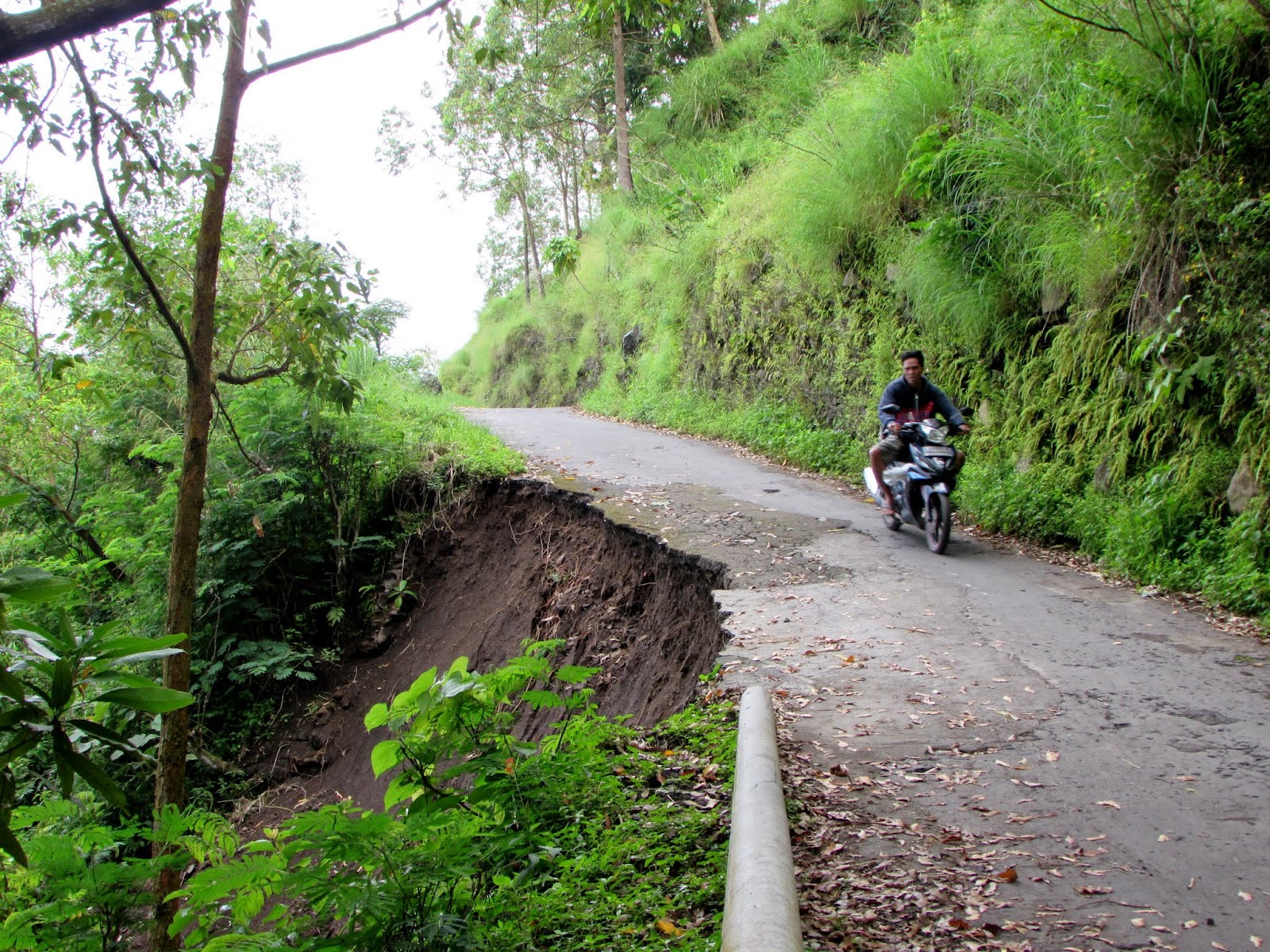
The road had caved in in an avalanche after heavy rains two days before Soraya and I arrived
Feet up!
Sunset
Lakeside farms on the way to Terunyan


So a few weeks later, in the evening after tearfully bidding my parents farewell, I forewent the large Ogoh-Ogoh monster-burning ceremonies around the island and instead, accompanied by my friend Soraya, drove up into the mountains and down around the crater lake just before the sun set. Even villages neighboring Terunyan celebrate Nyepi, and as we drove through them we heard the sounds of bombs going off (a typical part of rituals that involve burning something) and saw the streets lit with fire. When we arrived in Nyepi, however, it was business as usual for the most part. They had killed a ceremonial cow and made soup for the entire village with it earlier in the day. There are no restaurants or hotels in Terunyan, and so my friend and host Nyoman showed us to our room, which with a large mattress on the floor, an overhead light, and a TV, was extremely luxurious. The water levels had risen so high during this year's rainy season that the family had constructed a rickety pathway from bamboo beams to get to the house, and the room, which looked out on the lake, was only inches away from being flooded. Getting to the bathroom, which was on the opposite side of the compound, required clinging to the wall with one's fingertips, ignoring the large dangling spiders overhead, and crab-walking on a thin ledge so as to not fall in. It was perfect.
View from outside our door
The bathroom door. This picture doesn't do the incredible leap to the ledge justice, sadly
"So, what do you want to do? Go to the hot springs?" Nyoman asked. "My friend owns them."

The hot springs at the base of Mount Batur (on the opposite side of the crater lake) had escaped my mind when I set out to Terunyan, and 10 pm seemed rather late to go trekking in the dark, but after the long drive on hellish roads, soaking under the stars sounded fairly incredible. I was also confused because we would be driving through the other villages celebrating Nyepi, but Nyoman assured us that so long as we got back before midnight it wouldn't be a problem.

Nyoman was so matter-of-fact about the proposition of driving to a hot springs on treacherous roads in pitch-blackness that Soraya and I didn't really consider the possibility that it might be unsafe for us, two women, to go out that night with him and his friend (also named Nyoman). It wasn't until we were on the back of their bikes that I think it occurred to both of us that seen differently, the situation could be a serious lapse of judgment on our parts and quite dangerous. After all, we were alone and defenseless foreign women with two guys we barely knew driving on unknown dark roads. My train of thought went something like this:

"Hmmm, I hope these guys don't rape and murder us at the base of Mount Batur. I did tell tons of people where we were going before I left, and I also have given Nyoman hundreds of dollars in business by recommending him to my friends--I'm pretty sure I am of more value to him alive and happy then dead."


My rationalizing the situation came not from a place of fear, but rather a recognition that, seen by a third-party (my mom), the situation was an incredibly risky, horribly hazardous, almost-certainly fatal one--when in fact I felt quite calm and unconcerned by the fact that we were motoring around backroads with hulking older men.

Now that I have your attention, I will tell you that the Nyomans in fact had only the most honorable of intentions and were perfect gentlemen--after Soraya and I got to the hot springs (which we got in for $2.50 instead of the usual tens or hundreds of dollars people pay), we joked that we had personal bodyguards, as the guys continued to hulk around the side of the springs after we jumped in. It ended up being a wildly fantastic night--we insisted they get in and try the springs (hard to believe that after all those years of living across from them and shuttling tourists there, Nyoman had never jumped in himself!) and we all had fun joking and basking under the stars as the rest of Bali prepared for the upcoming day of contemplation.

The next morning, we got dressed in our ceremonial garb--sarongs and kebayas tied with a sash--and joined the village in the procession to their temple across the lake. The villagers, balancing offerings and lifting up their sarongs to keep them dry, squeezed into precariously rickety motor boats, as there are no roads leading to the temple. Once there, the villagers went up to the temple grounds to pray and participate in the ceremony, which honors the ancestors. The men had new shirts and shoes, and the women were covered in new gold jewelry, as in the days before the ceremony they venture out to the capital and spend heaps of money on new apparel. (Nyoman had spent 700,000 rupiyah--a little over fifty bucks--on new Quiksilver knockoff flip-flops. He acknowledged that they, as well as his new shirts with an enormous Ralph Lauren polo player logo, were likely knockoffs, but the act of buying new clothes with brand names made him proud.) As soon as they arrived many of the men started gambling as well--a part of the ceremony, they contended. Soraya and I were the only outsiders there, and we just tried to stay out of everyone's way as the entire village, ferried on small boats, fit themselves on this coved temple.


Approaching the temple dock
Soraya capturing the scene
With the Taruminyan (good-smelling) tree that allegedly keeps corpses from rotting--the only of its kind in Bali
Skulls (again)
After the ceremony concluded, Soraya, Nyoman, and I stopped by the Terunyan cemetery (see my previous post for more on this!) and then made our way back to the village. Soraya, who was a little under the weather, took a siesta, and I went to see the new main attraction--cockfighting. Cockfighting is actually illegal in Indonesia and I am absolutely against animal cruelty of any persuasion, but I knew that the fights, which again the villagers contest are a ceremonial tradition, would go on with or without me there. I weighed my choices: I could ignore inevitable animal brutality, or I could at least witness and acknowledge it while seeing a unique tradition that is likely centuries-old.

And so I went. I stood out even more--I was the only woman in a circle of hundreds of men yelling and waving hundred-thousand rupiyah ($8) bills in the air (although Nyoman told me that women in other villages gamble on cockfighting). I wanted to stay at the edge of the circle, not too close to the ring, but Nyoman insisted I sit in a ringside chair. Sitting next to the richest men in the village, it was a VIP location, a place where gamblers sit to see and be seen. I was still in my ceremony clothes and everyone started commenting on my great Balinese fashion--but thankfully everyone was very respectful, if curious. (They likely thought I was the wife of one of the richer men I was sitting near.) As the fights started, contenders would kneel with their chickens to size them up, and then two would be chosen to fight. Each man would then hold up his chicken, and the ringmaster and head of the village cockfighting society (whose house Soraya and I were actually staying in) would collect bets. The sound was enormous (see the video below) and so were the bets--I watched people betting hundreds of dollars on the outcome of these fights. It seemed they weren't afraid to bet significant chunks of their income, or even their entire salaries--that day, one man lost 20 million rupiyah (more than $1,500), and another won 28 million rupiyah (well over $2,000). You have to keep in mind that the overwhelming majority of men are farmers, particularly onion farmers, who sell a kilo of onions for a little over a dollar. 

A video posted by Audrey Woz (@audreywoz) on

After the bets were cast--literally, men would throw wads of cash into the ring--they strapped on long blades to the chickens and forced them to peck each other to rile them up. The fights went until only one chicken was standing--it didn't take long, and both of them would be killed shortly after. Winners were also repaid in chicken limbs--I narrowly dodged being swiped with a dismembered leg of the chicken that had just won the fight, awarded to some lucky better. Nyoman told me that even though people win and lose relatively huge sums of money, it doesn't matter so much because people are constantly borrowing and lending to each other. After he won sixty dollars, he immediately lent it all to friends who asked to borrow from him. Is cockfighting humane? Absolutely not. The villagers in Terunyan (and many Balinese people I have spoken with generally) have asserted it is a sacred ceremony; my rebab teacher told me that it represents sacrifice. (He also told me that there is coconut fighting and egg fighting in ceremonies. I have yet to verify this). In a way it's an interesting form of wealth redistribution seeing as everyone participates in these fights, and chances are participants will win and lose at various points over the years. 


Cockfighting knives 
Taking bets
That evening, while Nyepi was still going on for the rest of Bali, I took out a one-person canoe (hand carved, I might add) and paddled around the lake while looking at the stars. The boat was unwieldy and being on the lake in the dark (not far from a ceremony of unburied skeletons) was actually less romantic than I thought, but I have no regrets. The next morning, I woke up at 6 am and walked through the village and up the side of the mountain ridge opposite the volcano. I passed through clouds on the way up and walked by the occasional villager balancing heaping baskets of fruits and crunchy sweets to sell in the next village over, all of them surprised but accepting that I was jalan-jalan, walking around, on the incredibly steep path from the remote village on my own. A woman invited me to her village on the other side of the mountain, but thinking of Soraya still sleeping in Terunyan, I thanked her and told her I had to return--but not before she insisted on giving me some of the sweets she was bringing to the market. 

Terunyan gets a bad reputation in guidebooks; it is described as a village of scammers hostile to outsiders who tout their unusual local traditions to assert their superiority in Bali. Terunyan, with its trash-covered streets, boat culture, onion farms, cultural superiority complex, and of course incredible view of Mount Batur is my favorite place in Bali. It doesn't cater to tourists at all, and the villagers both acknowledge the uniqueness of their customs while holding onto their beliefs strongly. For me it is an incredibly peaceful place--there is an authenticity in everything from the trash that lines the cobbled pathways to the ancient temple that overlooks the fish farms opposite the looming volcano, as well as the customs to which they still adhere. Having had the rare opportunity to be a guest there, I found the people of Terunyan weren't resentful that I was there, but rather somewhere between indifferent and curious that was really refreshing--I didn't feel like I was intruding, and could actually imagine spending a month or more living there. I hope that can happen one day.


Soraya and I looked for Nyoman before we left--despite his insistence that we didn't need to pay him, we wanted to give him some cash as a token of our appreciation for all he had done (most of all, inviting us into his village and sharing their traditions with us). He called me later, pretending to be angry that I had paid him, and offering to buy me credit for my cell phone as a way of thanking me for bringing so many people to Terunyan. 


"No way, Nyoman," I told him. "You just lost six hundred thousand rupiyah on cockfighting. You're going to need that money." 


If you want an amazing guide for the Kintamani area, including the village of Terunyan, Mount Batur (the volcano), and the hot springs, call Nyoman Hariasa and tell him you got his number from Audrey: +62 0819 9956 4455


More belated blog posts coming soon! I hope to be up to date soon. Some final Terunyan photos until then--


Early morning


Terunyan under the clouds