Since I arrived in Istanbul at
the very end of April, people I meet have routinely asked me, out of curiosity
or social obligation, "How do you like Istanbul?" It would be a lot
easier to just show the pearly whites and say, "I like it a lot!" The
more honest answer that I still don't know, and it's still overwhelming in many
respects. I try to explain to the inquirer that I just came from four months
living in a village in Bali, a place where I was (at the end) established and
independent, a place where time seems to inch along slowly without anyone
urging it to go faster than it needs to, a place where people seem
"clinically happy" for how much they smile at each other without
provocation. I arrived here still despondent about leaving the island and the fantastic
experiences I'd had there, and also completely clueless about what to expect
about life in Turkey.
 |
| Seaside palace |
As you may recall, Istanbul was
not part of my original Watson project itinerary, but rather the suggestion of
Iranian kamancheh player Kayhan Kalhor, with whom I had discussed the obstacles
I was then facing studying music and living in Urumqi last fall. Instead of
going to Azerbaijan, as I had originally planned ("It will be similarly
difficult, but you won't be able to speak the language," he had pointed
out), he suggested I go to Istanbul and Crete, and put me in touch with master
musicians in both places.
As my departure for Turkey drew
closer, I was still completely unfamiliar with the culture and music I was
about to experience. I generally try to strike a balance between avoiding
preconceived notions and assumptions, and conducting exhaustive logistical
research, about a new place—I find it so much more rewarding to learn about a
place through experiencing it firsthand rather than trying to piece together a
picture from third-party, biased, or filtered narratives. Going to Turkey, I
tell you what I did know (or have in my mind)—I had studied Constantinople
(now Istanbul) briefly in the context of of an art history seminar in my senior
year of high school, so I gathered the place was (surprise) culturally
significant. Given its proximity to, and/or inclusion in, that vague area we
Americans label "the Middle East" and tend to only hear about in
ominous or threatening news reports, all of my family members expressed concern
about me going to Istanbul (especially as a white woman traveling alone—refer
to the
story of the murder of Sarai Sierra). They said they were unwilling to
visit me in Istanbul and encouraged (at some times, begged) me to reconsider
coming here. My only other context for Turkey was my time in Western China,
where Turkey and all things Turkish are in vogue among the Uyghur people.
 |
| In Istanbul, beauty and poverty are often side by side |
 |
| Galata Tower |
But back to
battling assumptions about Turkey—one of my greatest concerns about daily life
in Turkey was tested in my first week when I was lost and late on my way to a
Wellesley Club gathering, and it seemed that the best option was to take a cab.
After reading a multitude of travel sights that had warned about taxi scams, as
I hailed a cab I braced myself for being taken for a literal and figurative
ride. As soon as I got in and did my best to explain where I wanted to go, it
was immediately evident I was a foreigner, and the driver began sizing me up in
broken English:
"Erasmus?"
he asked, inquiring whether I was a foreign student on an Erasmus Scholarship.
"No..."
"Holiday?"
"No..."
"Business?"
"No, not
business."
He was
puzzled. "What are you doing in Istanbul?"
"I...I
study Turkish music! I play keman [violin],
and I want to study kemançe
[Turkish bowed string instrument]!" "Kemançe?!" The driver's
face lit up. "I am from the Black Sea [where kemançe is an integral part
of the folk music]!"
He reached
into the glove box and pulled out a stack of Turkish music CDs, fanning
them out like a poker player revealing his royal flush. He popped one in,
cranked the volume to its maximum, and turned around to gauge my reaction to
the sound of the tulum [Turkish
bagpipes] blasting the car and passerby alike.
This is not exactly what he played, but just to give you an idea of what was going on in the car:
In such situations, there is
only one correct response:
"It's
great! What wonderful music!" I
declared, forcing my grimace at the cacaphony into an enthusiastic grin and
some rhythmic head bobbing. Don't get me wrong—the music was excellent, but
after a certain decibel level even Turkish bagpipes lose their charm, believe
it or not.
Nonetheless,
he was pleased with this response, and glancing at the road from time to time,
sampled for me three or four more CDs from his collection while I affirmed for
him my deep and undying love of pop versions of Black Sea folk songs played at
stadium volume.
As we pulled
up to my destination, I reached for my wallet—
"For
you, who love kemançe, no charge!"
"No,
come on, I must pay you!" I said, taken aback.
"Just
give me two Turkish liras," he retorted, requesting less than one
dollar compensation for the four-dollar fare.
We went back
and forth, but he insisted I not pay him more than that. Then, he reached back
into his glove box and pulled out a CD with an outline of a man‘s face on the
front.
"Do you
know who this is?" he asked.
"No, I'm
not sure…"
He lowered
his voice for dramatic effect. "Atatürk," he said
reverently, referring to Mustafa Kemal Ataturk, founder of the modern-day
Republic of Turkey and nationally venerated quasi-god figure in
Turkey. "For you!" He handed me the CD, a compilation
called "Ataturk's Beloved Songs."
"No, no,
I can't accept this!"
After a lot
of back-and-forth and many heartfelt thank you's, I left the taxi with a radically altered stance on Istanbul's cab drivers (and Ataturk's Beloved Songs, of course—there was no way to
refuse).
My good fortune continued even
after I left the cab of the very generous and nationalist cab driver. As I
mentioned earlier, Kayhan connected me with a nationally renowned master
musician in Istanbul, Derya Turkan, a kemançe player who specializes
in Ottoman classical music. Given that Derya is in high demand as a performer
in Turkey and around the region, he has been extremely giving of his time and
concerned about my well-being in Istanbul. In his words: "If Kayhan sent you,
you must be special--I will teach you for free, and present to you many
musicians, and luthiers, instrument collectors." In my first week in
Istanbul, he made good on his word and brought me to his rehearsals for an
upcoming concert series with musicians from Greece. The ensemble included a
soprano sax player, a singer, a percussionist, and a Cretan lyre player
(picture the harp-like instrument Orpheus used to subdue the forest creatures
in Greek mythology, complete with turtle shell) performing a mix of improvisations on Ancient Greek songs
and American jazz standards alike. Conveniently, the common language between
the players was English, so I was able to follow the dialogue during rehearsal.
I was at the final rehearsal
before their concert the following evening when Derya announced that he would
not be able to perform with the group because he had been called early to
Belgium for his tour there. He left to prepare for his departure, but I stayed
to listen to the rest of the rehearsal because I enjoyed it, the Cretan lyre
player was borrowing my amp for balance purposes, and, frankly, I had nothing
else to do. On a break, the players started talking among themselves in Greek,
and then suddenly turned to me:
"Audrey, we were thinking,
maybe, if you would like, you could play two or three songs with us."
I was stunned and delighted that
they would ask me to join them—t hadn't crossed my mind that the possibility
would even be on their radar. The only problem—I didn't have my violin with
me.
"Maybe we could borrow one
for a few hours from a nearby music shop," they suggested.
And so, that is how I ended up
playing a dilapidated child-size violin (more box than instrument) with
Vassiliki, Aliki, and friends. I warned them that the sound was going to be
awful, and assured them that my own violin would sound much better. I also
warned them that I did not know anything about Greek or Turkish traditional
music styles—I could improvise, but it more than likely was going to sound
like Chinese and/or Indonesian music.
"Even better!" they
exclaimed.
Long story short, they really
liked my playing, and I ended up playing the entire concert with them (and
singing a song in Ancient Greek as well)! They were really pleased with how the
concert went, and hopefully we'll have opportunities to play together again in
the weeks to come. (I also have an open invitation to Athens—we'll see if that
can happen before it is time to come home!)
A few excerpts from the concert:
A few excerpts from the concert:

 |
| A view of the city from the island |


An oud player on a hilltop taught me this piece on the islands:
Derya also invited me to his
concert with Erkan Oğur, inventor of the fretless guitar and Turkish living
legend. It was good I didn't realize how famous he is until after I met him, we
had a very pleasant dinner, and he and Derya performed an incredibly moving
concert in a packed concert hall. It came up that they were traveling to
Cappadocia in central Turkey to play in a festival forty-eight hours or so
later; Derya asked if I wanted to come. I eagerly accepted the invitation,
booked flights, and a few days later met up with Erkan and their manager to go
to the airport. In the cab to the airport, I asked Erkan if he was really the
inventor of the fretless guitar.
"Yes. 1976." He told me
he had started as a violinist, studied to become a physicist, and then created
the fretless guitar so he could have the flexibility to play microtonal
makam-based music.
"Did anyone think you were
crazy when you invented the fretless guitar?" I asked him.
"Yes; my own teacher thought
I was crazy," Erkan said, telling me his teacher had passed away before he
could see Erkan's success with the new instrument.
When we got to the terminal, I
saw that the Beşiktaş soccer team was sitting at the same gate, occupied by the
hordes of fans asking for photos. Then, the fans saw Erkan, and soon he too was
surrounded by people complimenting his music and asking for photos. I saw that
one of the soccer coaches was eying Erkan; after a few moments, he strode up to
him holding a phone.
"Would you say hello to my
mother? We are huge fans!" I just tried played it cool—since, you know, Itravel with celebrity musicians all the time (joking, sort of...)
I had been told that Cappadocia
was visually stunning, but it wasn't until I was met by a canyon of man-made
caves and a veritable cave-castle from thousands of years ago that I understood
why everyone was raving about the place. After passing Mount Erciyes and gentle
empty rolling hills, the vivid canyon colors and rock formations come out of
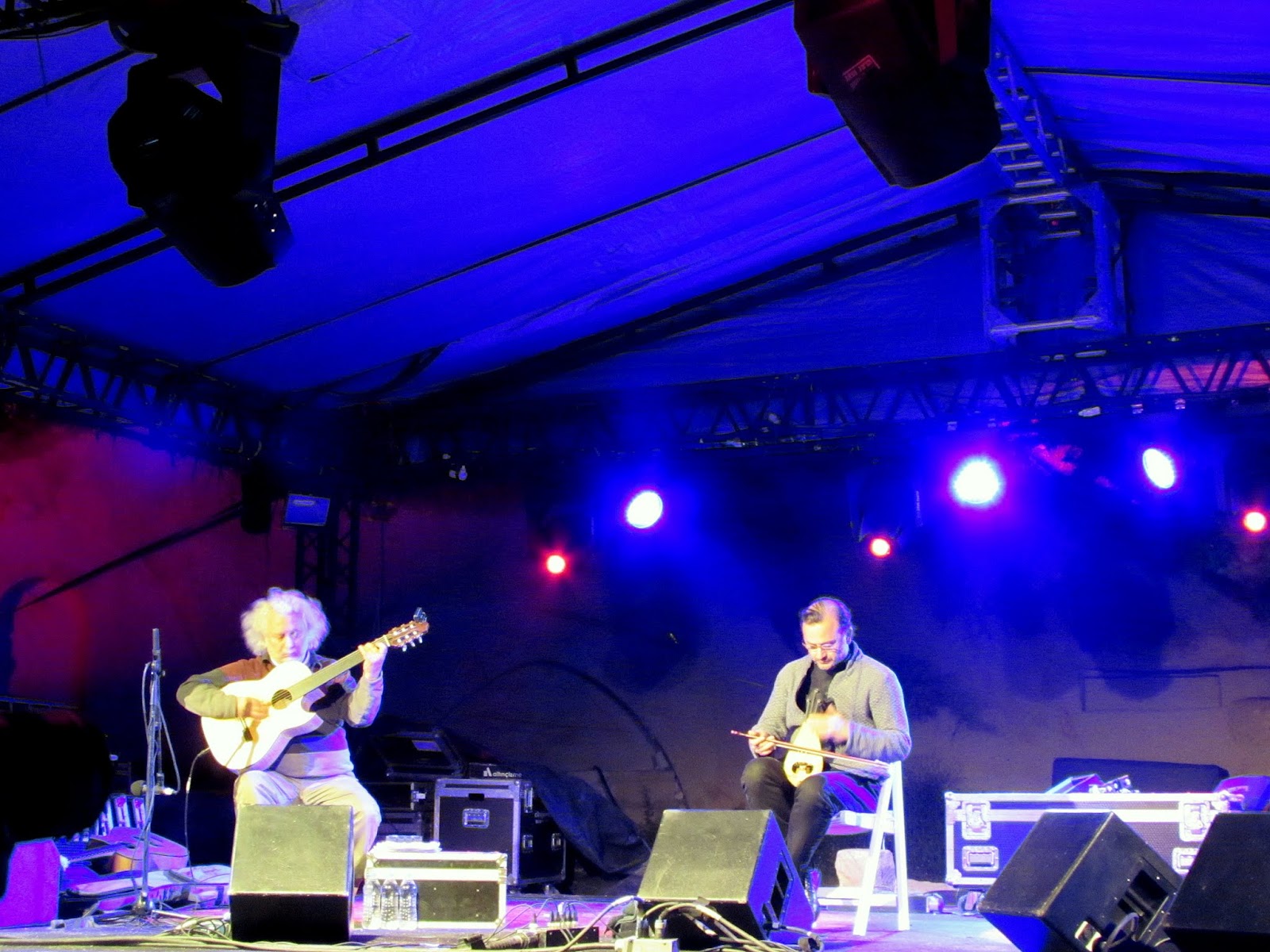
nowhere. Derya and Erkan's concert venue capitalized on the scenery—the stage
was perched on the side of Uchisar Castle, which is basically a huge rock into
which an entire fortress has been carved, and which overlooks a cave canyon.
The best part is how hands-off the local tourism bureau apparently is. I didn't
see any guides or rangers monitoring the area, and there are no barriers around
the caves, and so while Derya and Erkan had their sound check, I trekked and
scaled my way into the caves with my violin in tow (hoping to duplicate the
cave sound experimenting I had done with my friend and flutist Agustian in
Sumatra). Let me just tell you (and humor me while I wax poetic for a moment),
there is nothing really quite like playing violin while perched in the ledge of
a cave hundreds of feet off the ground and overlooking hundreds of miles of
central Anatolian landscape, nothing quite like hearing your own sound bounce
off and respond to the walls of a centuries-old Byzantine fortress. Derya and
Erkan’s performance was fantastic (especially since the night of the concert,
high winds threatened to topple the stage equipment off the side of the castle
cliff).
Cappadocia photo interlude—


 |
| See the person at the top of the fortress? |


I had stopped in Madrid on my way
to Istanbul to see my friend Rebecca (and mostly mope on her couch after leaving Bali); she more
than reciprocated by cheerfully coming to hang out with me in Istanbul. It was
great to see her; while I wasn’t completely emotionally settled with my change
of locale, I was far less depressed than the last time I saw her and relished
the chance to have a partner-in-crime with whom I could be a total tourist. We
went to the Grand Bazaar one day, and giggled at the ludicrous tactics the
salespeople use to get shoppers’ attention: “Hey sexy angel, let me show you
how to spend your money!” I also received a marriage proposal from a salesman
and the business card of a fur and leather merchant who asked if I would be
interested in modeling for his clothing line. “We have many Russian customers.
You would be good for this. You have face like baby.”
Marriage and fur modeling aside,
I had recently made friends with Feyza, a Turkish student in my neighborhood
studying environmental engineering, and invited her to join Rebecca and me as
we went to see the sights. A note to would-be tourists: everyone and her
grandmother wants to see the Hagia Sophia on the weekend—just don’t do it. The lines were
Disney-World-meets-visa-line-at-the-U.S.-Consulate-in-China long, and yet we
powered through, elbowing our way through the crowds at the dazzling harem at
Topkapi Palace and the eerie Basilica Cistern. By the early evening, Rebecca
and I were exhausted, but Feyza had a surprise for us:
“My friends have a boat, and they
are fishing. We can eat dinner on the boat.”
At that moment, I was so tired,
and the last thing I wanted to be doing was socializing with strangers trapped
on a dinghy, but at Feyza’s insistence we made our way to the pier. Imagine our
surprise to see a yacht waiting for us. Stunned, we greeted Feyza’s friend
Acilay, a girl our age with perfect makeup and a dream of becoming a Turkish
Airlines flight attendant one day, her middle-aged cousin, and his business
partner. They offered us tea, blankets, and a delicious dinner of the fish they
had just caught. Rebecca and I got a second wind, and just in time as Acilay
turned to me—
“Feyza says you are a singer.
Will you sing for us?”
I tried to explain that I was
first and foremost a violinist, but at the urging of everyone on board, I sang
two of my own songs. My performance was met enthusiastically, and soon everyone
was sharing a song. It came out that Acilay is a talented belly dancer, and we begged
her to demonstrate. She was fantastic, and she insisted we all get up and join
her as the yacht continued sailing down the Bosphorus.
All of the sudden, the music stopped—
All of the sudden, the music stopped—
“Now,” Acilay declared, “it is
twerk time.”
And indeed it was. Lest you think that was the end, I assure you we also had Black Sea dancing time and Balkan dancing time, and are looking forward to a reprise next week when Acilay graduates university.
And indeed it was. Lest you think that was the end, I assure you we also had Black Sea dancing time and Balkan dancing time, and are looking forward to a reprise next week when Acilay graduates university.
Classic Istanbul sights photo interlude—prepare yourself for a lot of tiles—
 |
| Blue Mosque |
 |
| Palace rose garden |


 |
| Hagia Sophia |


 |
| Basilica Cistern |

 |
| Blue Mosque |
Despite how wonderful it was to
explore Istanbul with Rebecca, as I frequently have over the course of this
year I found myself once again plagued by doubts about my project. I worried
that I wasn’t doing enough, and that the Istanbul iteration of my project
wasn’t unfolding quickly enough. It had been useful to meet with Derya when he
was available, as he took the time to break down and and explain the rules of makam in Turkish music. In such music,
the makam determines the set of pitches from which a melody is derived as well
as the rules for how it develops. One thing that is quite striking is that some
pitches in the makam are not fixed, but flexible, changing position within a
microtonal range depending on the direction of the phrase. For instance, in rast makam starting on D, the third
degree if the phrase is ascending is more or less an F#; however, if it is
descending, the pitch has glissando, sliding down from a pitch lower than F#
but higher than F natural. And, if the phrase teeters around that third degree
before descending, the first time it is close to F#, the second time it is
slightly lower, but still higher than the third time, when it has the glissando
to a lower pitch (still higher than F natural). You see?! It’s actually pretty
intuitive in a way—the pitches of the melody conform to its shape.
Coming back from my tangent on
Turkish music theory, Derya’s crash course on makams was useful to help me
start to listen more critically; however, beyond talking about the music I knew
I needed to play it if I wanted to internalize it. Luckily, promises of future
music-making have started to arise. I reached out to Tolgahan Cogulu, a
classical guitarist and professor at Istanbul Technical University’s Center for
Advanced Music who has invented his own microtonal guitar with adjustable
frets; he says he is happy to play makam-based music with me and is interested
in arranging some pieces using alternative tuning systems from China and
Indonesia for us to play together. Feyza’s friend Egesu is a guitarist and
conservatory student who brought me to an experimental open music
session—that’s where I met Sumru Ağıryürüyen, a prominent vocalist and
conservatory professor who specializes in traditional and improvised music
alike; she is interested in collaborating with me on a music project, and also
went out of her way to connect me with Turkish violinists.
And so that is how I came to meet
Baki Kemancı, a violinist whose name means “Baki the Violinist” (he was
literally born for this). I had been baffled listening to recordings of Turkish
violinists, as the timbre they achieve is so different that I would sometimes
wonder whether they were even playing the same instrument as me. Balki gave me
exactly what I had been searching for as he broke down and demonstrated the
technique—a slow, womp-womp vibrato combined with precise patterns of sliding
into pitches. The effect is relaxed and vocal, but very difficult for me
because in many ways it is opposite everything I’ve learned from practicing
Western classical music. I’m really excited—Balki is detail-oriented and has
high standards as well as the high intensity I need to learn a lot in a short
time. At the same time, he seems really friendly, and according to Feyza, he
said, “You and I, although we don't speak the same language or come from the
same music tradition, we understand each other’s music-making.” (Did I mention
he doesn’t really speak English? Ah well, as usual I’m putting my faith in the
language of music.)
It has felt slow going in these
past weeks, and for the first time I am starting to feel pangs of readiness to
be home. But, I have seen in this year how much can change and develop in just
a few weeks, and I am optimistic that there is still time for my project to
take a few more interesting turns before it’s all over. As always, I will keep
you posted—
 |
| Minaret sunset |