Selamat malam (good evening) from Bali! I hope you have had
a wonderful Christmas and New Year—mine was certainly memorable. These first weeks here mark the end of my chapter in China and new start in
Indonesia, complete with new music and a new language.
My departure from China stirred up mixed emotions. In
Xinjiang and Xian, I thought daily of my imminent departure for the southern
hemisphere with longing, nursing my omnipresent smog-induced cough and
shivering under the thin wool coat I hadn’t thought I would need when
originally projecting a hot climate-oriented itinerary. At the same time, as I
found myself becoming increasingly familiar with the erhu repertoire and easily
chattering away with friends and shop owners in Xian about their lives and
perspectives, I started to realize that I had reached a level of understanding
of Chinese language and culture that had previously felt unattainable. This is
not to assert that I achieved any sort of mastery of Chinese music or
incredible fluency in Mandarin language—absolutely not. What I can say I took
away from my time in China was the increased ability to perceive how the people
I was with comprehend the world around them. For the first time I found an
independent sense of comfort and ease operating within the social culture of
China. I felt like I was finally doing more than observing and mimicking, and
actually actively participating. Despite the political aims of the central
government, there is certainly not a singular, unified Chinese culture or
language; in particular, my time in Hong Kong and Xinjiang made that abundantly
clear. Nonetheless, in Xian I felt I hit my stride in terms of Chinese language
skills, music appreciation, and greater empathy with peoples in China. Again,
I’m not claiming expertise, but rather an increased capacity for experience
(already that sounds too lofty). My mom likes to remind me that the phrase for
“I’m sorry” in Spanish, lo siento,
literally means “I feel it.” That seems to come closest to how I regard
China—having glimpsed the tensions of Xinjiang and witnessed the protests in
Hong Kong, and also seen the clamor of audiences for music that rings true to
their cultures, perhaps I don’t know it—but I feel it.
My time in China started in Hong Kong, and so it seemed
fitting for it to end there as well. I bid farewell to my friends in Xian and
flew south to Guangzhou (long enough to have dim sum with my friend Haley and
capture some pictures of the incessant bridal photo shoots on Shamian Island.
Only my train to Hong Kong the next day did I realize that I was seeing
mainland China for the last time in the foreseeable future. I feel confident I
will be back (and back soon), yet only then did it sink in that I was leaving a
place that, despite its idiosyncracies, oddities, and injustices, holds special
significance for me. My days in Hong Kong over Christmas were a blur, though a
lovely one; I saw about fifteen friends in the course of five days, making time
to have a Christmas dinner with Alexis, Gloria, Paiyu, and friends, play
violin/piano and erhu/erhu duets on Lamma Island with Alexis, see some
Wellesley friends, and carouse with my Hong Kong University pals again.
[photo interlude]
Residents of these old buildings refuse to leave despite ongoing demolition efforts to make way for high-rises
Shamian Island fish market
Just roll with it
Christmas comes from Guangzhou
Christmas Eve dinner with Hong Kong friends
I am proud to say that I made this wreath myself
And in the blink of an eye, I found myself on a plane to Bali, seated next to my Wellesley classmate Poppy, who I had persuaded to trade in her high-paced corporate lifestyle in Tokyo for a few days of respite on a different island. Reunited after months apart, we regaled each other with stories of our respective lifestyles as of late and excitedly imagined the glamorous tropical adventure awaiting us. After months of gray, cold weather and surroundings, as I stepped off the plane I was overwhelmed by the wave of humid heat, as well as the lush greenery that seemed to be erupting out of every possible orifice.
I had arranged for us to stay with Lanny, the niece of my family friends, who purportedly runs a bed and breakfast. I figured that Lanny’s place would be a convenient base for both my vacation with Poppy and Watson project. What I hadn’t realized is that Lanny’s large courtyard-style house is first and foremost an Indonesian Christian retirement home that specializes in caring for residents with degenerative diseases, where Lanny hosts tourists and visitors from time to time. I believe we were the youngest guests who had stayed there—ever. Beyond the Christian imagery plastered on the walls and doors, the religious undertones of the establishment became acutely obvious our first morning there, when Poppy and I awoke to a synthesized organ accompanying a chorus of praise songs. We couldn't help but laugh—this was the farthest thing from what either of us had imagined our Bali vacation would be like, but in its own way the "home for those in their golden age," as it is called in Indonesian, was very peaceful. On our first day Lanny offered to take us to a few scenic spots, bringing us to a traditional Balinese village, an active volcano, and some enormous rice terraces. Coming from China, where art, architecture, and natural scenery are so rigidly controlled, it was incredible to see how "unbridled" Balinese art and culture are by comparison, as well as how much people still maintain and integrate centuries-old traditions in their daily lives. (Much more on this soon.)
Outside a Balinese temple
These chickens are real basket cases
There are chickens (and dogs) roaming around everywhere here! This one is particularly good-looking, no?
Polygamists in this village are banished and sent to live down this jungle path.
The sign apparently reads something like "Naughty Men"
This volcano erupted last year and the valley has not recovered from the damage
Can you spot Lanny and Poppy waving?
Despite the extremely tranquil atmosphere of the retirement home cum B&B, Poppy and I decided to seek slightly more lively digs for the remainder of her vacation. (We got the distinct sense our current hosts would not be ringing in the New Year in any particularly memorable fashion.) For better or for worse, we went the opposite extreme and doing anything particularly We ended up going to the opposite extreme and trekking out to the beaches of Kuta, a hotbed of Australian party tourism and really the last place anyone knowledgeable about Bali recommends visiting. But, truly setting aside the Watson Fellowship’s spirit of independent exploration, we figured “everybody’s doing it” and ventured forth to a quaint seaside hostel whose primary patrons seemed to have a wealth of hair gel, tattoos, poolside booze starting from noon on, and possibly performance-enhancing drugs. Poppy admonished me for not wanting to socialize with our new hostel compatriots; frankly, I found it hard to believe that we would have much common ground. Predictably, I did not enjoy the one night of clubbing with the bros that I consented to attend (the loud noise, belligerent drunkenness, and people pushing mushrooms right and left epitomizing the sort of seediness I have sought to avoid at all costs as a single female traveler).
Still, Poppy and I managed to have a really nice time. We took advantage of the cheap pedicure and massage places peppering the area, ate some amazing food, and even rented a motor scooter and took a road trip to a more secluded stretch of beach where we stretched out with coconuts and lots of sunscreen, still in disbelief that we had made it to Bali at all. (One of my favorite moments was Poppy going into a Balinese clothing stall wearing her corporate work blouse and leaving in an entirely new brightly colored outfit of loose harem pants and a breezy crop top.) Despite going through the motions of holidaymaking, however, I found myself having trouble enjoying our vacation. Being in a completely foreign culture and unable to communicate in the local language, I was plagued by insecurity. Making matters worse, my musical contacts in Bali were not responding to my inquiries, and so I was already picturing the state of turmoil and confusion I would inevitably enter once Poppy departed (and with her, any sense of familiarity or camaraderie in a strange place). I knew on an intellectual level that even if I had to start from square one everything would work out, but nonetheless my fear of being completely lost and lonely daunted me. It was actually amazing to have Poppy there for that reason as well—her disbelief at my inability to chill out and just enjoy being a tourist counterbalanced my propensity for working myself into an angst-ridden panic.
Gamelan ensembles at Denpasar Festival
At the hostel, besides the profane bro brigade we also met Joy, a Dutch nursing student who has been in Surabaya, a city on the Indonesian island of Java, for the last four months doing an exchange program. It was amazing to hear about how she has adapted to living in Indonesia (and in a far more unfamiliar place than touristy Bali) as someone with no previous experience here. At about the same time that I met Joy I got a very long and thorough message from a composer I had contacted, providing a wealth of advice, contacts, and supportive wishes. Between meeting Joy and receiving a veritable encyclopedia/phonebook of musical knowledge in Indonesia via email, I suddenly felt a huge weight lifted off of my shoulders. I didn't need to have my entire two months in Indonesia worked out, but having the information and moral support to jumpstart my project made me feel inspired again instead of overwhelmed. And just in time for New Year’s—that evening, Joy and Poppy and I (wearing my ear plugs, I am a wimp—but it’s important for us musicians to protect our ears!) went to the beach with hundreds of others and watched the fireworks that enveloped the shorelines as far as the eye could see. I made my New Year’s resolution: take full advantage of the opportunities in the moment; live fully knowing that this time is fleeting.
While my New Year’s Eve was truly spectacular, the first day of 2015 was a dud—I woke up early in the morning to throw up (not due to a hangover), had a minor traffic collision on the way to return the motor scooter that resulted in scraping another bike and bruising Poppy’s leg, and then returned to Lanny’s home for the elderly just in time to develop a high fever and become a sobbing, homesick, emotional wreck. Poppy was leaving on a flight that evening, and I can only imagine that she was as thrilled to leave as I was sad to see her go. Combating my body chills and aches, I told her I wanted to send her off at the airport.
“You definitely need to go to bed NOW.”
I did as I was told and called my parents. Being sick far away is really hard, and that was the first time since initially starting the year of travel that I really just wanted to be at home with my family. Although they were alarmed to hear me in my semi-hysterical state, I assured them and mostly myself that of all the places to fall ill abroad, a Christian retirement home that specializes in regenerative diseases was one of the best.
With Jonny, Fifi, and Lanny
I spent the next four days very quietly while trying to fully recover. I woke up, ate breakfast, and spent a few hours studying an Indonesian language textbook, and then the rest of the day reading or napping. In my altered state, the retirement home was the perfect place to be—everyone was pretty much on the same daily schedule, and additionally eager to let me test out my newfound language skills on them. As I started to feel better I went with Lanny and her brother and sister-in-law for small outings, during which time I became a master of making small but astute observations:
“That building is next to your house.” “This red fruit is delicious.” “Your name is Lanny.”
They were wonderful teachers—incredibly patient as I asked them a million and one questions about linguistic rules and cultural customs. I hope that I was able to give back to them in some way as well, even if it was just a little excitement in their daily routine. (In particular I think they were amused to take me fruit shopping. I got very excited to encounter a section of never-before-seen produce—hairy fruit, jackfruit, starfruit, snakefruit, and yellow watermelon.)
The recharge came at the right moment. Still, I realized that I would soon need to leave my own personal retirement and seek out the music. [To be continued...! Crazy stories of music-making with hippies, Indian classical music masters, and my nutty rebab teacher to come. Some music in the meantime—]
Given that, in describing my entrance into Xinjiang, such terms as "traumatic" or "agonizing" or "consuming all truth and reason" would not be amiss, it seemed that as I finally got settled in Urumqi there was no way things wouldn't start going my way. But three weeks in, that's just it--I guess I assumed that once I arrived I would get my bearings and things would just fall into place immediately. In fact, every single day around here feels like an uphill battle, and an especially frustrating one at that because so much of the time I find I don't have a clue about what's going on (even when I thought I did)! Even the smallest tasks can require wading through many iterations of bureaucracy and procedure (not my natural proclivity, as you may know). Lest you think I'm just complaining about language barriers and culture shock--yes, there's some truth to that, but it's more than just that.
For instance:
Instructions for enrolling in school as foreign language student
1) Email school at address posted on official website
2) Wait for email to bounce
3) Track down current exchange student to give you email address of exchange program director, send message
4) Receive no response because "she doesn't check her email during the summer"
5) Get cell phone number of exchange program director
6) Call and explain that you would like to take classes, get vague directive to fill out application
7) Submit application and receive no confirmation
8) Show up months later at school, hope for the best
Even now that I am theoretically enrolled in the Arts Institute, I deal with a host of daily challenges. It took me nearly two weeks to get the correct card to check out a key to a practice room because no one in the Music Department seemed to know the correct procedure--professors would direct me to other professors, who would point me back to the original person I asked. For a few weeks my ghijak teacher was not responding to my inquiries about when we could meet for a first lesson--I thought he had dropped me as a student. Classes change meeting times sporadically, or are canceled without warning (at least for those who aren't connected via social media with the teacher). Xinjiang also operates on two timezones--the official time, which like the rest of China is calibrated to Beijing, and unofficial "Xinjiang time," which is two hours behind. This is a constant point of clarification that recently was only further convoluted by the school's take on daylight savings time--shaving off thirty minutes from class start times in two directions. My ATM card still hasn't arrived, although I discovered that it had been languishing in the Urumqi FedEx facility for a week and a half because they didn't have the right address on it. Even once I contacted them and they assured me that they would deliver it within a few days, it is nowhere to be found and I am no closer to paying my rent. In other words, even the things that seem like they should run like clockwork, well, don't. Even the clock! When my sister and I were little our mom used to give us these stickers of frogs wearing prize ribbons with sayings like, "I tried my best!" and "I solved my own problem!" I'm keeping morale up now by mentally awarding myself a frog ribbon daily.
Besides my frustration about how difficult it has been to get started in Urumqi, I also was feeling a bit blue about how codependent I am on my host. She's absolutely lovely and I am learning a lot from her about local music and culture, but the fact remains that she has her own life, work, and circle of friends that I can only encroach on so much. In addition to such trivial tasks as calling FedEx Urumqi and getting student ID photos taken, I set myself the goal last week to "make friends." Hong Kong was such a crutch--between the vast sea of English speakers and the easily accessible online events postings, I had no trouble connecting with new people. Not so in Urumqi--for one, there is virtually no English except among the few expats here*, and you're considered lucky to come across a non-belated concert poster. Beyond that, I just have had trouble finding opportunities to plug in with the community at the Arts Institute because it is so insular.
*A side note about the expat community in Urumqi--from what I have been told the expats here are largely divided into two distinct camps: researchers and missionaries. While religion does underly many of the tensions in the region, I guess the missionaries are either discreet enough, or more likely considered a religious buffer against extremism by the government, to avoid notice. Still, they aren't discreet enough for the tastes of some here--my favorite anecdotes are the Uyghur who complained that the leaders of his English language circle "only want to talk about Jesus," and the missionaries in language classes who use biblical references in all of their example sentences.
This downtrodden note seems like a great lead-in for what shall be hereinafter referred "The Great Uyghur Baijiu Bash of 2015." A little background: months before I departed for my Watson year, I came across this gem of a video--a Uyghur music rendition of Michael Jackson's "Billie Jean."
It turns out that Abduwali, the musician himself, is an instructor in Urumqi, and the former teacher of a friend who just left the city. She had introduced us, and one evening I ran into him as I left the Arts Institute. We chatted and he invited me to come watch his ensemble's rehearsal, a Uyghur jazz combo-type affair. I eagerly agreed and watched them jam out until the bassist literally wore out his fingers. The musicians were great, and afterward some of them invited me to join them for dinner. We bonded over hotpot, one of them telling me about his Uzbekistan conservatory days and showing me videos of his award-winning performance in an international competition. They were excited to hear I was from Texas, and insisted they take me to Urumqi's aptly-named Texas Cafe after dinner ("It's owned by a Texan!" they exclaimed). Sadly, Texas Cafe was closed, but the night was just beginning. We went back to one of their homes, where they pulled out naan (Uyghur bread), a dutar (two-stringed lute) and a large bottle of baijiu, China's infamously pungent and potent alcohol of choice. After the musicians launched into singing muqam songs from Islamic poetry and Uyghur pop, they pulled out a shot glass.
"Us Uyghurs, we like to make long toasts and tell stories when we drink."
They filled up the glass.
"We are so glad to have met you tonight. We are your friends for life, and if you ever need anything, ever, let us know and we will help you! Hosh!"
They passed the shot glass to me.
"Uh....um...it makes me so happy to have gotten to know you tonight and heard your wonderful music. Ours was truly a fortuitous meeting tonight. I am so grateful for your help and hope that I, too, can help you in the future! Hosh!"
We toasted many things that evening ("To music!" "To friendship!" "Hosh!") and as we approached the end of the baijiu bottle, one of the musicians emptied it completely into the shot glass and handed it to me. I tried to politely refuse, but:
"This is me giving you my good luck! You cannot refuse!"
I figured that at least that would mean the baijiu consumption would be over. But then they pulled out a second bottle.
I just want to take this opportunity to clarify that until that evening, I had been drunk once in my life (one month prior) and had certainly never thrown up from drinking. In college, my exposure to extreme alcohol consumption was as the person keeping friends from choking on their own vomit. And so after I returned to my apartment that evening and slapped myself in the face to retain consciousness while throwing back liters of water, I had a chance for hazy introspection about the evening and where things had gone awry. My head was spinning and I was stumbling and slurring as I vocally coached my liver: "Hang in there--you can do this!" Barf. This is probably a sensation most of you have experienced long before I did last week; however, now that I have finally been naan-tossing drunk, I can confirm that the baijiu shots hellhole is one into which one should never descend, and that I have no intention of drinking to excess ever again. That said, I did feel a strong glimmer of pride as I stared into the toilet basin--I had gone to a Uyghur drinking party with fantastic musicians, held my own (at least in terms of speaking Chinese language), and left with self-proclaimed lifelong friends. Culturally speaking, this felt really significant because these types of get-togethers are a huge part of the social culture; moreover, as a female it was amazing to have had the chance to attend since gender divides are so strong in Uyghur culture.
As for less alcohol-soaked social gatherings, the girl who had introduced me to an erhu teacher at the Arts Institute has been very sweet and invited me to visit her family home in Shehezi, a town two hours away from Xinjiang. Her parents come from Gansu Province and speak Mandarin with a really strong accent, and so they would say something to me and she would translate it to more standard Mandarin. That said, we had some pretty eye-opening exchanges--for instance, they were amazed to hear that there are Chinese people in the United States who own Chinese restaurants where they make and sell dumplings. I gave her dad an English name, Mark, and then was at a loss when he immediately asked, "So what does it mean?" I looked it up and got "Mars" and "warlike," which I didn't tell him, so I settled for a happy medium: "It means you're fiercely awesome!" He seemed placated. Her family was welcoming to a fault, insisting that I sleep in their daughters' single bedroom while both of their daughters slept out on the couch. I felt bad (also stuffed because I had gorged myself on the aforementioned dumplings) but they wouldn't have it any other way. As for Shihezi itself, if you have the chance to go, I wouldn't--the city was constructed fifty years ago in the middle of the desert as a semi-colonial project. With massive streets, empty monolithic buildings, and a gentrified Han population it has all the charm of a waiting room. (Surprisingly it is home to a university of 40,000 students and participates in many international exchanges. Regardless, I can without a doubt say I have seen it, and helped you dodge a bullet in the process...)
I have had my first two ghijak lessons, and while it's still to early to offer any serious commentary on the learning process, it's a great time to post a new video of lackluster stringed instrument playing! Ghijak presents unique challenges from erhu, especially since it has four strings instead of two and the bow, which is not attached to the instrument, has a higher contact point with the string than it does on the erhu. My biggest challenge right now, beyond keeping the bow on the string, is keeping the bow on the right string--the whole instrument pivots on the spike that rests on one's lap, so there is a swiveling motion to account for when playing that I have never dealt with before. I really like my teacher, though. He's a really nice guy who is seriously picky and sounds like he is screaming all the time; in fact he just cares a lot and tends to talk loudly, especially about the history of Uyghur instruments and music. He showed me this very cool instrument which he called the "grandfather of the erhu"--it looks like a large erhu with a metal body and five sympathetic strings (not played but that vibrate when the two main strings are played). Because of the sympathetic strings and the metal chamber the instrument echoes the notes long after they have been played, and the sound has a distant and haunting timbre not unlike a sitar. He complained that no one wants to study the instrument these days, and I told him I was very interested, so tentatively I am going to take lessons on both instruments! In the meantime, here's the video status report on ghijak and erhu:
I regret that there are not more pictures in this post--I haven't been toting my camera as freely because I don't want to draw attention to myself and also don't want to jeopardize anyone whose image I might post. That said, I'm working on it--more pictures to come!
While the Watson Foundation does not require its Fellows to produce a research paper or findings from their year abroad, they do ask for quarterly reports in the form of a "long letter home." Mine is due today, and I thought I'd share it on the blog as well.
Dear Chris, Michelle, and Sneha,
Greetings from Urumqi, where at the moment I am sitting in a
muqam performance class at the
Xinjiang Arts Institute. Since the class is taught in the Uyghur language and
thus I can’t really appreciate much more than the music, I’m also practicing
writing the Uyghur alphabet in the hopes that picking up even a bit of the
language will serve me during my time here.
I want to let you know that starting off my Watson in Hong
Kong was truly a phenomenal experience, daunting though it was at the
beginning. My first few weeks were overshadowed by trying to salvage my Wall
Street Journal internship, only to find out that a variety of circumstances had
made it impossible to do it at all this summer. (WSJ is happy to have me come
back for the internship next summer/fall after my Watson year, which is my
current plan.) So in my first week I was without a plan or established network.
On my first day of ‘funemployment’ I went to lunch by myself, and then decided
I would walk uphill for as long as I could. Four hours later I was at the top
of Victoria Peak, where the usually panoramic view was entirely obscured by
thick mist. I resigned myself to a contemplative walk down the mountain, which
went smoothly until I spotted a huge, face-sized spider dangling nonchalantly
overhead. I am deathly afraid of long-legged spiders, and seeing this one I
felt myself start to hyperventilate. I suddenly realized that Hong Kong is in a
tropical environment, as is Indonesia, another of my Watson year destinations,
and if I were going to survive this year I would have to accept the
inevitability of spiders and learn to keep my cool even if they were hanging
over my head. And I’m pretty sure the spider was a metaphor.
Later that day I walked into a random music school and
signed up, sight unseen, for erhu
lessons. My teacher ended up being a patient, talented, and generous young guy
who, beyond teaching me how to play the instrument, shared his insight on
attitudes toward music acquisition and preservation in China, and also invited
me to join his Chinese orchestra. I performed with them for their Mid-Autumn
Festival concert on erhu and as a solo violinist, playing a Cantonese opera
piece and a violin showpiece.
One of the biggest things I took away from my time in Hong
Kong was how interconnected the world is if you are open to it, and proactively
seek out new connections and opportunities. I was warned by multiple previous
Watson Fellows that this year would be lonely and miserable. Thus, expecting
this would be the case, I made an events calendar, attending everything from an
experimental jazz vocal concert to a dramatic reading of short fiction. I set
up meetings with acquaintances of acquaintances, and then volunteered to help
them out on their projects, no matter whether they seemed related to my own
project or not.
And in fact, even those activities and connections that
seemed so tangential ended up serving me in major ways I would never have
foreseen. I worked closely with a composer and music critic who
I met through a markets editor at WSJ. She invited me to a
concert she was reviewing, at which time I discovered she had done her graduate
studies with composer Lou Harrison and played gamelan on the recording of his
work that inspired me to play it and write about him for my senior honors
thesis. I volunteered to assist her in her work in any way I could, and soon
was regularly going to concerts with her, traveling out to the island where she
lives to help her with her work, and play her music (which draws on both
‘Western’ and Chinese influences).
Through the composer I met multiple wonderful
people, including a Chinese linguist and professor at Hong Kong
University who became my Mandarin teacher, mentor, and closest friend. He is a
renaissance man with a self-declared ‘perfect’ memory and extremely strong
democratic leanings despite having grown up and studied in northwest China.
Discussing notions of cultural purity and propaganda in music with him in
Mandarin helped my language skills, and made me think about the potential
political and cultural implications of performing music from an “outside”
culture or with ideological ties. “The thing with propaganda music is,” he said
one time, “you may be singing ‘The Sun is Red,’ but the melody is really nice!”
I won’t go into the play-by-play of how I fell into all of
these projects (I have recounted them on my blog) but here are
some of the other highlights, in no particular order:
Coaching chamber music for a quintet of middle school boys
Becoming a classical music reviewer for TimeOut Hong Kong
Meeting John Thompson, a preeminent scholar and performer
of Ming Dynasty guqin, on a far-flung
island
Taking a few-day trip to Hangzhou, where quite by accident
I met some of China’s top erhu players. I traveled with them to a rural village
to meet their master teacher and join their family reunion, and then put on a
recital of my own in a public square
Working at Hong Kong University’s Centre for Journalism and
Media Studies a day or two each week in exchange for free housing at one of the
Residential Colleges (I was named a “Junior Visiting Scholar” and a “good role
model for the students”). I also joined HKU’s Gamelan Ensemble and played
violin and erhu with HKU students
Spending multiple nights observing the Hong Kong democracy
protests
Without realizing it, I had found a really wonderful niche
in Hong Kong through the incredible relationships I had formed, and the
prospect of leaving the place that was never supposed to be part of my Watson
project became overwhelming. Many people, including my mother, suggested I not
leave Hong Kong at all. But while there was so much more I could have done had
I stayed longer, it felt important to stay faithful to my initial proposal, and
that I would be cheating myself if I didn’t get out of my comfort zone.
And so, I arrived a little past midnight in Urumqi two weeks
ago, a trial-by-fire start to my time in Xinjiang because my host had mixed up
the date I was arriving and wouldn’t be returning to the city for two more
days—which I discovered after the airport shut down at 2 am. Also, I had
discovered a few days prior that my ATM card had expired and was subsisting on
the cash I had borrowed from a friend. (I am still waiting on my new ATM card
to arrive—fingers crossed it makes it!) I ended up getting in an unmarked car
with a strange man and going to an airport hotel I could barely afford, where I
started freaking out. Thankfully my host got in touch the next day and put me
in contact with my first friends in Urumqi.
Things have steadily improved from that low point, although
adjusting from a largely English-speaking, generally politically free island financial
capital/culinary paradise to a frigid Uyhgur-speaking [SELF-CENSORING] that subsists on carbs and lamb has meant some significant culture
shock. I am in my second week here, but only now starting to get my Xinjiang
sea legs. I am planning to take a week long detour to Taiwan and Shanghai at
the beginning of November to shadow Yo-Yo Ma’s Silk Road Ensemble for part of
their Asia tour. I was only planning to spend two months in Xinjiang, but
because it has taken me this time to settle in, and because I will be taking
that week away, I am thinking that for this part of my year to be productive
(in terms of learning erhu and ghijak, a Uyghur stringed instrument,
and Uyghur and Mandarin languages) I should stay longer than I originally
planned—possibly through some of the winter (so much for my plan to avoid
freezing climates). I also am really enjoying learning erhu, and am vaguely entertaining the notion of going back to
Hangzhou to find those erhu musicians
and study with them—they offered to teach me after all! I am still wrangling
with questions about how to prioritize my time, energy, and focus, so of
course, if you have any insight I absolutely welcome it.
Okay, muqam class
is out—time for Mandarin! Hope all is well with you.
After
spending my last night in Hong Kong sleeping in a gutter with student
protesters, I left the city where I had spent two and a half months to travel
to my next destination—Urumqi. Urumqi is the capital of China’s northwest
province of Xinjiang, which borders Kazakhstan, Russia, Mongolia, Kyrgyzstan, Tajikistan, Afghanistan, Pakistan and India. There are no
direct flights from Hong Kong, and so I took a late morning two-hour high speed
train to Guangzhou, where I took the subway to the airport, crossed my fingers
that the airline wouldn’t hassle me about checking my overweight bag and
bringing two instruments and a carryon onboard (they didn’t), waited four hours
for my flight, started to feel my separation from Hong Kong, and then got on
the five hour, 7 pm flight to Urumqi. Thankfully it was exceedingly smooth, but
as I looked out the window and didn’t see any lights for hundreds of miles, my
sense of isolation began feeling more acute. I told myself that it was okay—my
host, M, would be meeting me at the airport and I would soon be around people
who cared about my survival again.
I
arrived without fanfare after midnight at Urumqi’s Diwopu Airport and waited
for M, who was arriving in the airport from vacation in another city in
Xinjiang ten minutes after my flight landed. Ten minutes turned into thirty,
and then an hour. Flight delays in China are a common occurrence, so I knew I
just had to be patient and she would show up. As the number of people waiting
to pick up friends and family at the airport dwindled and M was still not
around, I began to worry—she was my point person here and the person I would be
living with, and without her I was essentially clueless about Urumqi.
At 2
am all the flights had landed, the airport was shutting down, and M was nowhere
to be seen. I was losing my shit. A few women advertising hotels had come up to
me in the previous two hours; one came up to me as the gates started coming
down, and I asked her how much the cheapest room would be, mentally calculating
how long I could stretch the money I had with me (remember that I discovered a
few days ago that my ATM card is expired). Seeing no other options, I consented
to letting her arrange a room for me, and then was directed to the ‘free
airport shuttle’—an unmarked black compact car ferried by a strange man. My
brain was too haywire to do more than recognize my internal alarm bells going
off, and I deliriously contemplated a life of sex slavery.
Luckily
this particular shuttle did not take me to a life of destitution, but rather to
a barebones Super 8 Motel outside the airport, where they let me lowball the
room deposit because I couldn’t scrounge up the full amount. The internet
worked long enough for me to send a telegram-like email to my family assuring
them I was still alive, and re-read my email exchange with M, discovering she
had mistook my arrival dates and would be arriving two days hence. I got in bed
still disgusting from the day’s travel. I wondered what I would do, where I
would stay, and how I would pay for the following nights, realizing that
regardless I would need to come up with a plan before checkout at noon the next
day.
I
slept until 10 the next morning, and then realized I had one other number—the
international student program director of the Xinjiang Arts Institute, with
whom I had corresponded briefly in the weeks prior. I called her, explaining
the situation as best I could, and asking if there was a hotel close to the
Institute where I could stay. She gave me a recommendation for a place next
door (“The rooms are not big, but they are cheap,” she said) and I haggled with
a driver outside the Super 8 to take me across town to the Institute, which is
firmly nestled in the part of town dominated by the Uyghur ethnic minority
population.
I
made it to the hotel and arranged a room, but needed to first change my Hong
Kong currency to Chinese yuan to pay for it. The banks in the area were closed
for the holiday of Qurban, so I used my remaining cash to take a taxi to the
main Bank of China branch. I didn't even end up changing my money at the bank—a
slew of ‘money peddlers’ lined up outside the bank, and I consented to let a
very persistent one buy my Hong Kong dollars. I undoubtedly lost a few dollars
in the process, but he took all of my loose change off my hands, which the bank
would not have done (and remember I was physically and emotionally drained). I
finally made it back to the hotel and checked in, and felt my bewilderment and seclusion
swallow me up.
Just
as I felt myself succumbing to utter sorrow and fatigue, I got a text from M:
“Do you want me to introduce you to some of my English-speaking friends at the
Institute?”
“Yes,
that would be amazing!” I tried to text her back. My phone was out of minutes.
Half
an hour and two China Mobile stores later, I was back in business. I got the
number of some of her researcher friends at the Institute and called them,
explaining my situation and asking if I could become a barnacle to their
metaphorical ship. They told me they were at lunch with friends, but graciously
invited me to go along with them to meet another friend in a few hours. I went
to a hole-in-the-wall restaurant that thankfully only served one dish, and sat
there contemplating all that had transpired in a mere twenty-four hours.
~
Meeting
M’s friends was a godsend. They were incredibly kind and good-natured—taking me
out to eat, doing my laundry (!) and telling me about their struggles and
successes adjusting to life in Urumqi. Just having someone who could sympathize
with my tremendous stress and culture shock made the next day and a half bearable.
~
I am currently coming to terms with the fact that
for now, and likely for a long time, it will be impossible for me to write freely
about the things I see and hear on a daily basis. I will still, to the best of
my ability, write about my own experience studying music and language in Urumqi.
But until I can tell a more complete story myself, I urge you to learn what you
can about current affairs in Xinjiang and know that there is so much more that remains unsaid.
~
There
hasn’t been a day since my arrival when I haven't cried, when I haven't been overwhelmed by waves of acute emotional pain. There is much to look
forward to in my time here, and I am safe. But I am in mourning—for the
relationships I left behind in Hong Kong, for Hong Kong itself, for my current
self-censorship, and for the reasons I have to do so for the foreseeable future.
I'm much overdue on writing, and life has been an absolute whirlwind since I last wrote--from having my 21st birthday to traveling around Shanghai and Hangzhou for a week (a blog post in and of itself)! Now that I'm firmly back in Hong Kong, I am doing my best to get caught up on my endeavors here and also delve more deeply into my project. But I relish the chance to reminisce on how lovely the last few weeks were as I fill in the gaps on my blog...
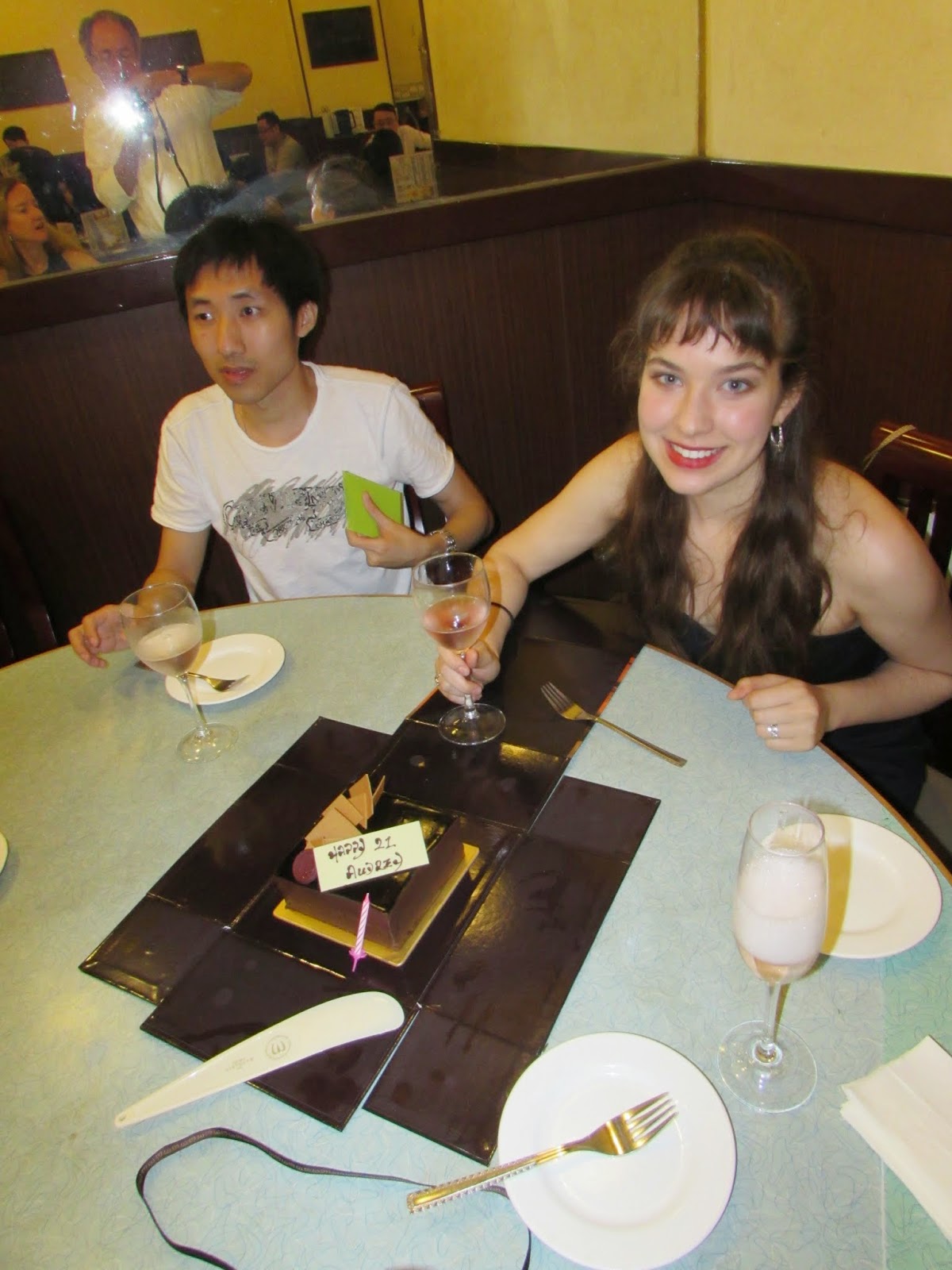
Last year, working abroad in Guangzhou, China, was the first time I had a birthday away from home. It was a Tuesday, I went to my internship as per usual. While my coworkers were so nice to bring me a cake and sing me Happy Birthday, I remember feeling acutely sad to spend the day being far from family and friends. With the loneliness of last year's birthday in mind, I dreaded the coming of my 21st birthday here in Hong Kong--especially since while in the U.S., turning 21 carries special significance (whether that entails the ability to drink or the general coming-of-age sentiment) that it doesn't elsewhere. In fact, my 21st birthday ended up being the most wonderful and special birthday I have ever celebrated--in no small part due to the fact the celebrations didn't seem to end!
My week already had an incredible start--I hiked to a gorgeous remote beach on the south side of Hong Kong Island with a few friends. A few days later I watched the sunset from Hong Kong's "secret natural infinity pool," a dammed waterfall high in the mountains near Tai O, a fishing village on stilts in Lantau Island. In other words, I started the week already feeling pretty mellow--but things only got better from there.
In my erhu lesson the previous week, my teacher Nick had invited me to come watch the rehearsal of the Chinese instrument ensemble in which he performs. In my lesson during the week of my birthday, he changed his mind: "I think you could play in the rehearsal--you can try the easy pieces." He gave me a stack of scores, denoting the ones he thought were within my abilities, and the time and location of the rehearsal. I didn't have enough time to work through the music, but I figured I would nonetheless go and try my best to sightread, and at the least just observe their practice. As fate would have it, I got lost in pouring rain on the way to the rehearsal, and finally located the rehearsal room right before it began. I walked in and confronted a terrifying sight: a large ensemble of players already in position to start, jabbering away in Cantonese. Nick gestured at the spot next to him: "Come sit here!"
You have to be kidding me, I thought. The spot he pointed to was, in orchestral terms, the assistant concertmaster's seat--in front of all of the other players, reserved for the ensemble's second-in-command, and right under the conductor's nose. Confronting this veritable musician's nightmare, I squirmed into the seat and tried to not make eye contact with anyone as I sheepishly pulled out my erhu. I silently berated myself for not looking at any of the music beforehand*, but it was too late, the conductor had raised his baton and we were off.
Here's part of the music from "Horse Racing"
*A side note about Chinese musical notation that I meant to make earlier: much of Chinese music is not notated using the Western music notation system of a five-line staff with note heads and key signatures. Instead, many pieces use a system of numbers that parallel the solfège system of movable do--in other words, in any given piece, the first note of the scale is indicated with a 1, the second scale degree is 2, and so on. Dots above the number indicate a higher octave and dots below indicate a lower octave. If a piece is in the "key of C," so to speak, 1 will be a C, 2 will be D, etc.; if a piece is in the "key of D" 1 will be D, 2 will be E, etc. There are bar lines and time signatures, but lines underneath the numerals indicate their rhythmic value. If you are confused, don't feel bad--so am I.
While I didn't sound particularly grand, and there were many places where I just couldn't keep up, I actually found that I was picking the music up quickly, and actually having a lot of fun. I had no idea what was going on (I know only enough Cantonese to determine what measure number we would start from) but I remembered how much I love the feeling of playing as part of a larger ensemble. In the past, that has always been an orchestra, and indeed, playing Chinese music in an orchestra-like setting felt bizarre, but I found that the nuances of playing in an ensemble (timing, coordination, balance) directly translated. After the rehearsal, Nick and the conductor came up to me. "Actually, we think you can play all of the erhu pieces in the performance. Also, we were thinking you could play a solo on violin, too." Anyways, talk about going from zero to sixty! I'm going to be leading a Cantonese opera piece, 帝女花, on violin, and then playing the Kriesler solo violin piece I previously posted. The performance is this Friday evening in honor of the Mid-Autumn Festival, and I have invited a bunch of friends, so the pressure is on!
(Here's a link to the Cantonese opera piece I am playing on violin!)
So this overwhelming but absolutely fun Chinese instrument ensemble rehearsal, and unexpected performance opportunity, was a huge birthday gift in and of itself. But that wasn't the end of the birthday celebrations! Over the course of the week I met up with friends from Wellesley, my friends from the Wall Street Journal, and my former music theory professor. Then, I was touched to hear from my good friend in Hong Kong, who wrote to me saying she wanted to host a birthday party for me. We invited many of the people in Hong Kong who have welcomed me and helped me with my project, including Alexis, the composer, my erhu teacher and my Chinese linguist friend, and over heaping platters of steaming delicious Cantonese-style food I told them how much their friendship and support meant to me. I also heard from my little sister, who had without my knowledge, solicited birthday video messages from my friends and family, and compiled a short movie of well-wishes (as well as many of them singing me Happy Birthday)! It was truly the best gift I have ever received--and looking back, on what I had expected to be a day of loneliness I felt tremendous love, support, and connection. I am sure that there will be days that are absolute personal lows in the months to come, but I can say confidently that my birthday was not one of them--in fact, it was one of the best moments in my life.
It's all very well and good to submit a proposal to explore new and far-flung places for a year, but if you say you're going to find a ghijekmaster teacher to work with in Urumqi, and by some miracle some person or organization decides yours is a worthy cause to fund, then, well, you had better find yourself a ghijek master teacher in Urumqi. Believe it or not, this is somewhat trickier than perusing the yellow pages--looking for Yelp in China's Xinjiang Uyghur Autonomous Region does not, in my experience, yield a successful result.
In fact, besides not having any idea how I would secure housing in rural outlying villages in Azerbaijan or Indonesia, one of the most daunting aspects of this project was trying to conceive of my day-to-day existence, how I would pursue my project on a practical level.
Just to clarify, I still don't know exactly how I'm going to find a place to live in the fringe villages of Azerbaijan or Indonesia, but my current tactic of active avoidance, denial, and blind faith has proven comforting so far.
My initial approach to the latter concern was to blindly google such phrases as, "mugham Azerbaijan," "cimbalom band Czech Republic," "Uyghur music Xinjiang," etc. and hope that the resulting links and articles would immediately reveal the keys to the musical kingdom. Get it? Keys? Like musical keys? Actually, most of the musical styles I hope to study don't adhere to a harmonic system that uses the Western music concept of key signatures, but I digress. My nebulous googling did produce some useful tidbits; for instance, I noticed that the Chinese government had announced construction of Uyghur music centers around Xinjiang, and that there was an international mugham festival in Baku every March. I slowly refined my searches, looking for music conservatories, cultural centers, local festivals, as well as ensembles, composers, and researchers in my places of interest. Everything was fair game, from Facebook to the Fulbright Scholar database. I compiled a tangled list of names and contact details for anyone who seemed like they might have any remote insight on the musical cultures I wanted to explore, and created a massive spreadsheet. Rotary Clubs and radio DJs made it on this list. So did prep school music teachers and crossover violinists and many, many corpulent gentlemen in traditional Moravian folk costumes.
And then came the inquiry emails. Emails upon emails. Tens, dozens of emails every which way, each one sent with the hope that some aspect of my self-introduction and ambiguous description of my project would resonate with the recipient. (This is a technique my mom refers to as 'shotgunning.') A lot of the messages bounced right away, and even more went unanswered into cyberspace. And who could blame them?
Here was the gist of my message:
Dear Madam/Sir,
Mucho gusto! I'm an American student and violinist *hoping* to win a lot of money to study traditional music styles in your area. I don't really know anything about them, but it appears you might. Is that true? Can you hook me up?
Rock on!
Most sincerely,
Audrey "Andrew"* Wozniak
*In my experience, "Audrey" can be a difficult name for some non-native English speakers to wrap their heads around--I frequently have an unwitting alter-ego named Andrew, or if I'm lucky, Andrei.
But then a handful garnered a response. In some cases, it was merely a suggestion of someone else to contact who would be more qualified or knowledgeable. (Cue more emails.) In a few cases, I stumbled upon people who were genuinely interested in my project because it so closely related to their own work. Among these were Jesse and Elise, Fulbright Scholars studying music and doing ethnomusicology research in the Czech Republic and Xinjiang, respectively, who patiently answered my questions about the local music scene, connecting with musicians in the area, language learning, housing options, traditional customs, and more. Jesse gave me tips about cultural festivals in Brno, while Elise offered to set up music lessons at the university where she studies.
After this first round of shotgunning, I continued to solicit help in finding contacts for my Watson project--often inadvertently. I didn't necessarily go around to every person I knew asking if they had a pal in Hungary; however, as word of my travel plans inevitably got around to my friends, professors, acquaintances, and even perfect strangers, people began volunteering information that could help--whether it be that they had friends in Indonesia, or that there is an sheet music app that would basically eliminate my need to bring stacks of paper on my journey. My violin teacher warned me about stringent import/export laws regarding instruments and ivory (found in some violin bows), and offered to lend me her carbon fiber bow for the year. My professional jazz pianist friend hooked me up with his pals in the embassies in Azerbaijan and a Czech military wind band conductor. I was invited to visit Macau, Tibet, India, and Burma on my journey, and have had the chance to discuss my project with world-class musicians, composers, and scholars in the States and abroad. I mentioned this in an earlier post, but it's fascinating how the world seems to organize itself around mugham musicians when that's what you need--in fact it hasn't. Observing a niche network reveal itself to you when you previously had no idea that it even existed is a source of awe. It's also a reassurance that you don't need to weave a new web, per say, but can allow yourself to tap into something much bigger than yourself.
At this point, old worries about not knowing how to go about "doing" my project have dulled to a low roar in my head, to be replaced by more pressing matters. For your reference and mine, I have compiled lists of some of my previous worries, as well as some that have arisen.
OLD WORRIES
Is it possible to die of loneliness?
How do you find housing in Azerbaijan/Indonesia/every place I'm going?
What am I actually going to do on a daily basis?
How weird is it to ask people to teach you their traditional music styles for adaptation to a non-traditional instrument (aka my violin)?
How do I find said people?
How do I know what places to go, in what order, and for how long? And how do I arrange visas?
Is it worth it to try to learn a language for just two months?
How am I going to work out in each place?
I can cook eggs three ways, and steam vegetables. Will I starve?
NEW [MORE] WORRIES
Will I wreck myself if I'm on anti-malaria antibiotics for four months? Is it better to just contract malaria, and take antibiotics then?
[Related: Will daily doses of Deet for months have adverse consequences for my well-being? Am I getting the right bug spray brand to ward off Indonesian mosquitoes?]
Will my parents constantly worry about my well-being, as they have told me daily for months now? If so, can they handle it? Will my little sister applying for college be enough to distract them?
Can I form and maintain meaningful relationships with others when I am going to be on the move for a year, if not two or three or more?
Who am I? What am I doing? What does it all mean? [This is actually an old worry, but it always arrives fresh when I least expect it.]
What the hell am I going to pack? Can I pack efficiently without condemning myself to the zip-off pants look? Is this the time to start experimenting with natural regulation of body oils and stop washing my hair? [Answer: it is not.]
These, dear readers, are the questions that keep me up tossing and turning these nights. If you have the answers to any of them, by God, don't hold back.
 Selamat malam (good evening) from Bali! I hope you have had
a wonderful Christmas and New Year—mine was certainly memorable. These first weeks here mark the end of my chapter in China and new start in
Indonesia, complete with new music and a new language.