Showing posts with label journalism. Show all posts

Friday, October 10, 2014

Grievances and mourning

After spending my last night in Hong Kong sleeping in a gutter with student protesters, I left the city where I had spent two and a half months to travel to my next destination—Urumqi. Urumqi is the capital of China’s northwest province of Xinjiang, which borders Kazakhstan, Russia, Mongolia, Kyrgyzstan, Tajikistan, Afghanistan, Pakistan and India. There are no direct flights from Hong Kong, and so I took a late morning two-hour high speed train to Guangzhou, where I took the subway to the airport, crossed my fingers that the airline wouldn’t hassle me about checking my overweight bag and bringing two instruments and a carryon onboard (they didn’t), waited four hours for my flight, started to feel my separation from Hong Kong, and then got on the five hour, 7 pm flight to Urumqi. Thankfully it was exceedingly smooth, but as I looked out the window and didn’t see any lights for hundreds of miles, my sense of isolation began feeling more acute. I told myself that it was okay—my host, M, would be meeting me at the airport and I would soon be around people who cared about my survival again.

I arrived without fanfare after midnight at Urumqi’s Diwopu Airport and waited for M, who was arriving in the airport from vacation in another city in Xinjiang ten minutes after my flight landed. Ten minutes turned into thirty, and then an hour. Flight delays in China are a common occurrence, so I knew I just had to be patient and she would show up. As the number of people waiting to pick up friends and family at the airport dwindled and M was still not around, I began to worry—she was my point person here and the person I would be living with, and without her I was essentially clueless about Urumqi.

At 2 am all the flights had landed, the airport was shutting down, and M was nowhere to be seen. I was losing my shit. A few women advertising hotels had come up to me in the previous two hours; one came up to me as the gates started coming down, and I asked her how much the cheapest room would be, mentally calculating how long I could stretch the money I had with me (remember that I discovered a few days ago that my ATM card is expired). Seeing no other options, I consented to letting her arrange a room for me, and then was directed to the ‘free airport shuttle’—an unmarked black compact car ferried by a strange man. My brain was too haywire to do more than recognize my internal alarm bells going off, and I deliriously contemplated a life of sex slavery.

Luckily this particular shuttle did not take me to a life of destitution, but rather to a barebones Super 8 Motel outside the airport, where they let me lowball the room deposit because I couldn’t scrounge up the full amount. The internet worked long enough for me to send a telegram-like email to my family assuring them I was still alive, and re-read my email exchange with M, discovering she had mistook my arrival dates and would be arriving two days hence. I got in bed still disgusting from the day’s travel. I wondered what I would do, where I would stay, and how I would pay for the following nights, realizing that regardless I would need to come up with a plan before checkout at noon the next day.

I slept until 10 the next morning, and then realized I had one other number—the international student program director of the Xinjiang Arts Institute, with whom I had corresponded briefly in the weeks prior. I called her, explaining the situation as best I could, and asking if there was a hotel close to the Institute where I could stay. She gave me a recommendation for a place next door (“The rooms are not big, but they are cheap,” she said) and I haggled with a driver outside the Super 8 to take me across town to the Institute, which is firmly nestled in the part of town dominated by the Uyghur ethnic minority population.

I made it to the hotel and arranged a room, but needed to first change my Hong Kong currency to Chinese yuan to pay for it. The banks in the area were closed for the holiday of Qurban, so I used my remaining cash to take a taxi to the main Bank of China branch. I didn't even end up changing my money at the bank—a slew of ‘money peddlers’ lined up outside the bank, and I consented to let a very persistent one buy my Hong Kong dollars. I undoubtedly lost a few dollars in the process, but he took all of my loose change off my hands, which the bank would not have done (and remember I was physically and emotionally drained). I finally made it back to the hotel and checked in, and felt my bewilderment and seclusion swallow me up.

Just as I felt myself succumbing to utter sorrow and fatigue, I got a text from M: “Do you want me to introduce you to some of my English-speaking friends at the Institute?”

“Yes, that would be amazing!” I tried to text her back. My phone was out of minutes.

Half an hour and two China Mobile stores later, I was back in business. I got the number of some of her researcher friends at the Institute and called them, explaining my situation and asking if I could become a barnacle to their metaphorical ship. They told me they were at lunch with friends, but graciously invited me to go along with them to meet another friend in a few hours. I went to a hole-in-the-wall restaurant that thankfully only served one dish, and sat there contemplating all that had transpired in a mere twenty-four hours.
~

Meeting M’s friends was a godsend. They were incredibly kind and good-natured—taking me out to eat, doing my laundry (!) and telling me about their struggles and successes adjusting to life in Urumqi. Just having someone who could sympathize with my tremendous stress and culture shock made the next day and a half bearable. 
~

I am currently coming to terms with the fact that for now, and likely for a long time, it will be impossible for me to write freely about the things I see and hear on a daily basis. I will still, to the best of my ability, write about my own experience studying music and language in Urumqi. But until I can tell a more complete story myself, I urge you to learn what you can about current affairs in Xinjiang and know that there is so much more that remains unsaid.

~


There hasn’t been a day since my arrival when I haven't cried, when I haven't been overwhelmed by waves of acute emotional pain. There is much to look forward to in my time here, and I am safe. But I am in mourning—for the relationships I left behind in Hong Kong, for Hong Kong itself, for my current self-censorship, and for the reasons I have to do so for the foreseeable future.

Thursday, October 09, 2014

The highest of tables and lowest of gutters

As I mentioned in a previous post, one of things that had been keeping me busy in Hong Kong was helping out at Hong Kong University’s Journalism and Media Studies Centre (JMSC). A close friend introduced me to Ying Chan, the director of the program, and I volunteered to help out with the JMSC’s work in any way I could. This has entailed everything from writing press releases for their website to writing the English language press kit for an Oscar Award-winning documentary filmmaker. In exchange for my work, Ying has hosted me at one of HKU’s residence halls for the last month and a half—an amazing and unbelievably generous arrangement given housing costs in Hong Kong. I had to laugh when I moved in, though—I would not have thought that so soon after graduation would I be living in student dorms, eating in a dining hall, and shuttling to campus in a school bus.

And then came High Table Dinner. For those of you who are unfamiliar, High Table Dinner is a tradition from the British education system in which students don robes and eat together at long tables overlooked by a ‘high table’ at the front of the hall where the distinguished faculty, masters, and tutors sit. (For those of you who are familiar with the Harry Potter dinners in the Great Hall—it’s the exact same concept, minus floating candles). I didn’t actually know any of this when Ying invited me to join the High Table Dinner at her residential college, but happily accepted the invitation, which instructed attendees to dress up or wear their national costume. Since draping myself with a large American flag or dressing up like the Lady of Liberty seemed fairly out of the question, I decided to wear someone else’s national costume and showed up wearing my newly acquired qipao (the high-necked ladies’ dress of China).

When I arrived at the Great Hall, I was given a long black robe (denoting post-graduates, distinguished faculty, and masters) and told to line up outside behind Ying and the other faculty while the students took their seats inside. Out of the blue I heard a trumpet fanfare, and the procession started to move. Suddenly I found myself filing down the middle aisle past lines of students who rose deferentially. I followed the procession all the way to the front, where I stood by a seat miraculously marked with my name. Little did I know that Ying had actually seated me at the High Table itself, seated among the distinguished faculty members. A few days earlier, one of my friends who lives at the residential college, a master’s student in music composition, had asked if I was going to ‘crash the High Table Dinner.’ As I stood at the front regarding the students in my regalia, I saw him rolling his eyes, gesturing with mock-indignation as I smirked from the front. Ying introduced all of the very accomplished college masters and tutors, and then introduced me.

“This is Audrey. She just graduated from Wellesley College in the United States. She has this very fantastic scholarship to travel to five countries and do nothing! Please talk to her so you can find out how to get scholarships.”


So, quite the introduction! But the meal went on and I found myself chatting amicably with the student organizers and a professor of architecture. Ying had asked me to play violin at the dinner, so after everyone was done eating, one of the tutors set up a music stand immediately in the middle of the students and I launched into my piece. I had asked a good friend about something short and pleasing to play for this gathering, and he had recommended I listen to Swallow Song (燕子/Kharlygash), a very melancholy love song about two lovers stuck between the border of Xinjiang and Kazakhstan. The lyrics are simple but adorable:

燕子啊
请你听我唱一支燕子歌
亲爱的请你听我说一说
燕子啊

燕子啊
不要忘了你的诺言变了心
我是你的你是我的
燕子啊

啊
眉毛弯弯眼睛亮
脖子匀匀头发长
是我的姑娘
燕子啊

Swallow, ah…
Listen to me sing a swallow song.
Dear please, listen to me say a few words
Swallow, ah…

Swallow, ah…
Please do not forget your promise and change your heart.
I am yours, you are mine.
Swallow, ah…

Ah!
Eyebrows arched, eyes bright
Graceful neck, long hair
She is my girl.
Swallow, ah…


After watching this video I was completely sold (on both the song and the outfit) and transcribed it for violin. It seemed to go over very well with the High Table dinner crowd, and I was glad because afterward it gave tons of students the excuse to come talk with me. I felt so lucky—in that one night I made about twenty new friends. (A large group of them invited me to come out partying with them later that evening, another episode that again reminded me that I am no longer in college.) In particular I got to know an entire floor of girls in the residential college, with whom I relived my college experience through a couple of rounds of late night snacking, watching videos and movies, and gossiping about secret crushes. It was fun to witness their college experience now that I am on the other side of it and having such a radically different experience—I was just in their shoes a year ago, but now our concerns on a daily basis are so radically different from each other.

I scored a terrific gig writing classical music reviews for TimeOut Hong Kong, the city’s cultural and arts magazine and website, and so had the tremendous good fortune to get free tickets to the concerts I was planning to attend anyways, and then foist my opinions of them on the general public. What’s not to love!? I felt lucky to have taken a class at Wellesley partially devoted to writing concert, record, and book reviews, but nonetheless, before writing my first review for TimeOut, I felt pretty insecure to be judging musicians far more accomplished than myself. As I attended my first concert, however, I found that my reaction to the performance came easily—I didn't need to worry about coming up with the substance for a review. I reviewed three concerts in total before my time in Hong Kong came to a close, and the exercise of articulating what was successful and unsuccessful in others’ performances was really illuminating for me as a performer. I think in particular I came to appreciate how much of music performance is visual—the audience wants to see the players onstage interacting and engaging with each other and the music. It also became blatantly clear that even those concert-goers who aren’t music aficionados can appreciate the difference between players who are just playing the notes, and those who are so in touch with the music that they can inflect their own interpretations naturally.

My last days in Hong Kong were somewhat bizarre. There were some in the company of close friends, enjoying each other’s company for the last time in the foreseeable future. I went on a final junk boat trip, which was a beautiful day devoted to relishing island life. I had my final erhu lesson with my teacher, after which he took me to get lunch, erhu accessories, and my phone repaired. I had a last night in the dorm, spent watching a terribly acted Cantonese movie about prostitution in Hong Kong with my new friends from HKU. I went out with a few friends and their mothers for amazing food, and had a really nice outing with pals from the HKU gamelan ensemble I had joined for the last few weeks.


Hanging with the po'
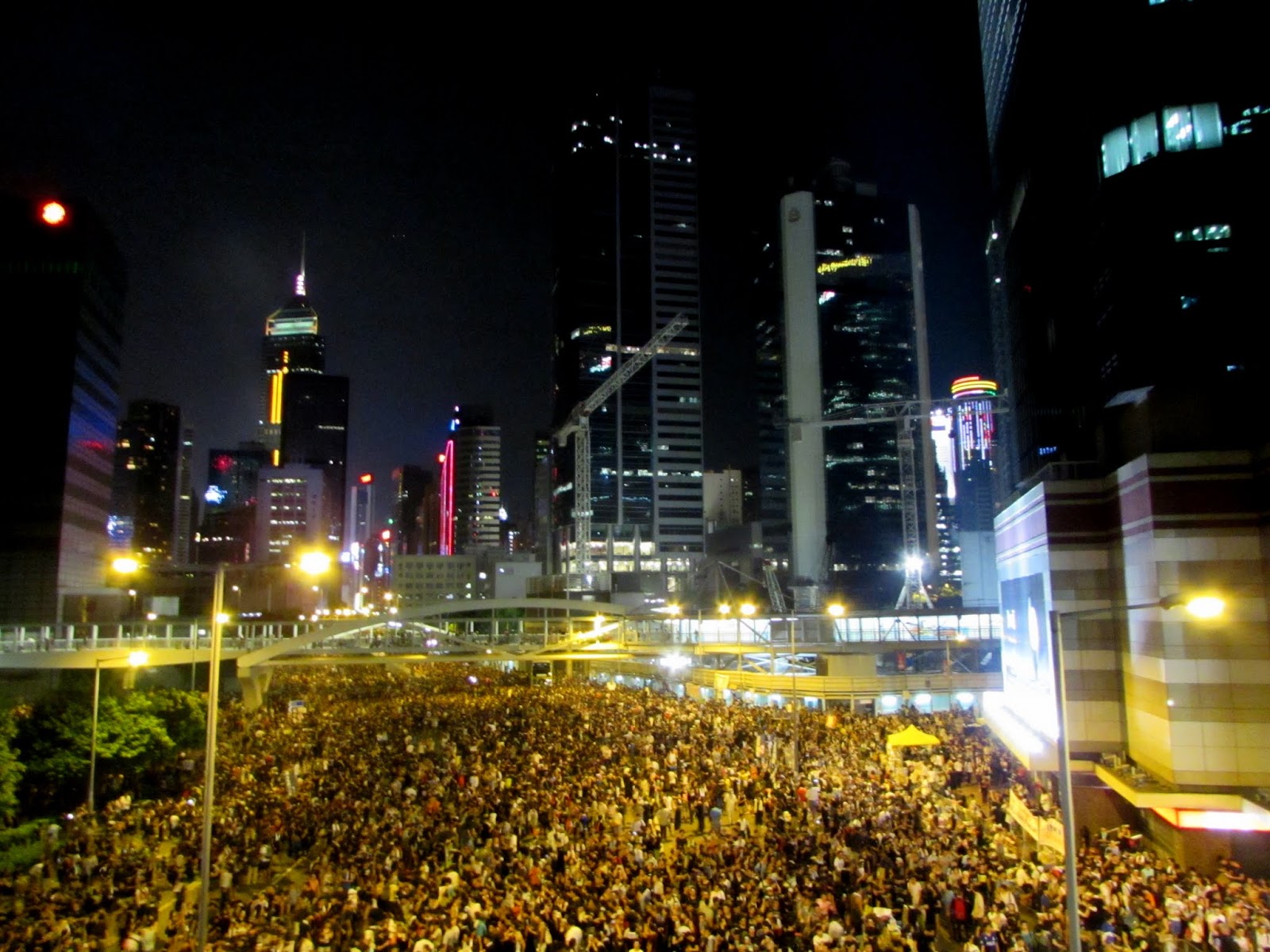
My evenings for almost the entire last week, however, were spent helping my former supervisor ABC News with their coverage of the pro-democracy student protests in Hong Kong that have been going on in full force for about a week and a half. (See my previous reaction post regarding the Hong Kong protests.) My ‘schedule’ for my last week in Hong Kong was spending the day working on various tasks or meeting up with friends and acquaintances, and then sometime between 8 and 10 pm meeting up with the news team, gearing up with cameras and gas masks, and then staying out to help them film segments and report live until 2 to 4 am. My role was that of ‘protest sherpa,’ guiding the team around the protest area (which I had visited before they arrived), providing real-time facts and rumors, carrying tons of bags, finding people for them to interview, and turning on my benign Texas charm to get past huge security blocks and police cordons. Rumors about what would happen were spreading like wildfire, and on the first night we went out (the day after police used tear gas) the reporter told us to treat the situation in the field like a warzone, prepping us on protocol in case of riots or violence. The atmosphere was tense, but for the first few nights the protests in Admiralty resembled a music festival more than a demonstration of civil disobedience: tons of couples, singing and cheering, street art everywhere, and people offering free food at every turn.

We kept anticipating some dark turn for the protests, whether that be students storming the Hong Kong Chief Executive's private home or police using any means necessary to clear the highways for National Day, which commemorates the founding of the People’s Republic of China. There was certainly was hostility, especially in the Mong Kok protest area, where paid thugs and/or disgruntled locals used their fists and not their words to address the protesters occupying the streets. But at least for now the prophecies of a second Tiananmen Square massacre have not been realized.

Staying up late every night and then trying to function during the day soon began to catch up with me. I started forgetting small and big things. My mind became occupied by the protests—I compulsively checked for reports and new developments, thinking something would change and I would miss it. I felt myself becoming consumed with worrying about the protesters, worrying about the future of Hong Kong, worrying about the fate of Chinese citizens on the whole. When I dragged some of my belongings I planned to send back home down the hill to the post office in torrential rain and found out my ATM card had expired, I basically lost it. I felt out of control of so many things. I confronted my sudden destitution, impending separation from my newly familiar and comfortable home and friendships in Hong Kong, and the fact that I could only observe the course of the protests. My good friend came to the rescue, fronting me cash and reminding me that I was cold, wet, hungry, and overtired.

My last day in Hong Kong was a string of get-togethers with close friends, after which I planned to go out for a last night of protest coverage. That evening Hong Kong's Chief Executive had publicly promised to clear the streets, and so tensions were high as rumors flew that there would be a massive crackdown. Before I went out I had one final ferry ride with a violin and erhu out to the island to see Alexis. She and I played erhu duets as well as her music, Mozart, and Arensky on violin and piano. We had intended to put on a final chamber music recital together with her former composition student, a cellist, but the cellist dropped out a few weeks prior, and then the protests took over my schedule, and the space we were going to use for our performance was already booked, so the odds were against us. Getting to see her and have a peaceful moment of music on an island so far removed from the Hong Kong hullaballoo was a godsend—and in many ways a final moment of calm before the storm.

Loading
After a lovely afternoon of playing Mozart, Arensky, Alrich, and erhu duets, a bittersweet farewell and "see you again" with Alexis on Lamma Island
After seeing Alexis, I got together with Paiyu (renaissance man, Chinese linguist and historian extraordinaire, and my very close friend and Mandarin teacher) for dinner. He has been incredibly generous with his time and energy helping me in Hong Kong, from editing a paper I am publishing to prescribing me traditional Chinese medicine. Like me, he has strong feelings about the student protests, but on that last night we agreed to not talk about politics. Instead, we talked about classical music and inane topics over dumplings while we watched a propagandized news report on the protests come on the TV, watching images of students and police shaking hands flit across the screen. We parted ways, and he urged me to stay safe that evening as I got in a cab heading toward the protests. “Send me a progress report on your paper!” he called. “See you again soon!”

I arrived at the protests, where the number of protesters was significantly less and the mood was palpably fearful. The ABC news team was prepared to stay out until 6 am to witness the protests, and so we got to work. I spotted student leader Joshua Wong in the crowd near Umbrella Man, the newly erected wooden sculpture holding aloft a yellow umbrella that is to the Hong Kong protests what the Lady of Liberty statue was to the Tiananmen Square protests. After a brief interview and a quick report for one of the news programs, we were in a holding pattern waiting for something to happen.


As the night dragged on I walked around the area, watching students drag trash cans to reinforce barricades meant to prevent attack by police buses and rogue taxi drivers. Others studied in an effort to keep up with the classes they had been skipping the entire week. Many were asleep, spread-eagle on the pavement or wrapped tightly in saran wrap or sleeping bags by highway medians.

At 4 am I found myself drifting off as well, curled up in the gutter next to a pile of cigarette butts and the drain. It didn’t seem to matter.


At 6 am the producer woke me up. It was time to leave, and for me to travel to Urumqi.

Wednesday, October 08, 2014

On the Hong Kong protests


I am long overdue on writing, and as I do so now it is a particularly climactic time, both for myself and for Hong Kong. Much has happened in the last few weeks that I would like to write about, but for the last week, the pro-democracy protests in Hong Kong have occupied my nearly every waking moment as well as mind space. I had heard discussion of the student movement and “Occupy Central” before this week, but as I watched the live stream of peaceful protesters bombarded with tear gas by heavily armed police, I became absorbed in the news and felt the same helplessness and vulnerability that I felt during the week of the Boston bombings. For the past six nights I have gone out to the protests with my former supervisor from ABC News’ Beijing bureau to help with ABC’s coverage of the unfolding events in Hong Kong. I have heard many perspectives—students who are fervent champions of democracy, mainland Chinese who believe Hong Kong citizens are selfish and should stop complaining, apathetic or unsympathetic locals who just want their everyday lives (and ability to use main road arteries) to return to normal…I believe that wanting to nominate and elect one’s own leaders in a free and fair election is not an unreasonable desire, although as someone pointed out to me today, Hong Kong for most of its history has not been democratic (though it has benefitted from having free markets).


A Hong Kong financier observing the protests told us that the protests are a symptom of the younger generation of Hong Kongers feeling trapped in society—the Hong Kongers don’t have high enough Mandarin language proficiency to work in mainland China, nor high enough English proficiency to work in the States, Canada, Australia, or Europe (and the available visas for these places are dwindling as well). In the meantime, the banking and finance jobs that have powered Hong Kong’s economy are going to mainland Chinese, who are also buying up real estate in Hong Kong and driving housing costs through the roof. In other words, the future the young generation of Hong Kongers face is bleak—even if they find a job in Hong Kong, they are unable to move out of their family homes or face twenty-five years of paying loans to just afford tiny apartments.


I feel strongly that people have the right to freely disseminate information and express their own views, and the massive censorship and information manipulation in both mainland China and Hong Kong that has accompanied these protests is extremely disturbing to me. Statistics show that online censorship of posts relating to the protests in Hong Kong is at an all-time high in mainland China—far exceeding censorship rates on even sensitive days such as the anniversary of the 1989 Tiananmen Square protests. Instagram has been blocked across mainland China in an effort to prevent images of the cell phone light vigils, the incredible street art, the huge police presence, and of course the tens of thousands gathered, from being seen and potentially emulated across the entire country. I want to hope (or be idealistic, a word that has been used to describe many of the student protesters) that such a public demonstration in Hong Kong, the final frontier of democracy in China, can fundamentally shake the Chinese government at its core and proliferate across China. I also realize how many factors are working against the protesters, not the least of which is the antipathy of much of the population of Hong Kong. Whether they are paid mafia thugs beating up students in Mong Kok or local shopkeepers incensed that their businesses are suffering because of the protests, perhaps an even greater strain on the protesters than the threat of a crackdown from Beijing is the pressure from fellow Hong Kongers to stop disrupting society. Rather than a large showdown between protesters and the People’s Liberation Army, this movement may die at the hands of Hong Kong citizens themselves, urging it out of existence.

I have tried to remain neutral as I assessed the situation this week; indeed, in the past few days I have both spent time sleeping amidst protesters on the occupied highway and standing among police behind the barricades and cordons. Nonetheless, my natural tendency is to sympathize with the pro-democracy protesters. By many measures American elections, with just two candidates who have achieved their status through corporate lobbying, can hardly be called free. Nonetheless, I find it very difficult to imagine a situation in which I could not feel any concern about the potential implications of infringement on my ability to express myself freely. As it becomes more and more absorbed into the Chinese system, the Hong Kong system is not becoming more independent, and I worry that the entire society will suffer in the long-term as it undergoes the process of assimilation.

I have absolutely fallen in love with Hong Kong. It is hands-down my favorite city I have visited, and I could imagine myself living here in the future. After this week, however, I worry that the future is not bright for Hong Kong, and that this city I have come to love is transforming into a shadow of its former self.


(posted late due to internet accessibility issues--follow-up on my last weeks in Hong Kong, and notes on my current locale, to come soon!)

Saturday, August 09, 2014

Starting from scratch, and scratching from the start

Last week I was absolutely stressed out about how to spend my days in Hong Kong. I hadn’t originally intended to begin my Watson project in the so-called ‘Pearl of the Orient,’ yet I suddenly found myself here with an apartment already leased for a month and nothing to do. While I may have termed myself ‘funemployed’ mere days ago, I am proud to announce that my status has shifted to ‘fun-employed’ (i.e. occupied in enjoyable ways). I would go so far as to declare that I am nearly too busy—but only in the best of ways.

Island barbecue!
I have been amazed at the number of people I have met in just two weeks—each one with his or her own fascinating story to tell, and interest in helping me with my project in some way. For instance, I have been assisting Alexis, the composer in Hong Kong, with her work, and so delighted that she invited me to a barbeque she hosted at her home on one of Hong Kong’s outlying islands. The first person I met there, Paiyu, is a Chinese linguist, and as soon as I told him that I have a special interest in as well as previous experience studying Chinese linguistics, he was eager to tell me more about his work, offer to introduce me to other prominent linguists in Hong Kong, and invite me to go out for tea (which I learned last summer actually means go out for a Chinese food feast). He is one of a dozen people in the world who speaks Tangusic languages, and he’s also a Mandarin Chinese teacher, so I’m thinking of soliciting him for language lessons for my remaining time in Hong Kong. The second person I met was Gloria, a graphic designer with an incredibly outgoing personality and eye for style. She wrote to me a few days after the barbecue, and I had an incredible afternoon hanging out with her in her gorgeous self-designed studio apartment (which has been featured in the newspapers here). She showed me her work, and is bringing me to her friend’s art gallery party in a few days—the friend being someone who is extremely well-connected to the Indonesian music scene and regularly brings musicians to perform in Hong Kong.

Lamma Island
Taking the ferry home from 'work'
Hong Kong Island at dusk

In the meantime, beyond going to intensive Mandarin tutoring a few times a week and helping out Alexis with her work (as well as playing her own music with her!) I’ve also taken on a new role helping out at the Journalism and Media Studies Centre at Hong Kong University. Thanks to a very close friend with ties to the JMSC, I was able to meet a few of the professors and staff there. After offering to lend a hand in any way I could, I’ve found myself writing press releases for them, researching for their Open Data initiative, and creating an English language press kit for the newest film by an Oscar Award-winning documentary filmmaker in residence at the JMSC.  

These are just a few of the dozens of people I’ve met in this short time, and I can but only feel incredibly lucky. That said, it’s not just luck—I’ve been making huge efforts to get out of my apartment and meet people, whether through going to badminton meet-up groups or reaching out to as-of-yet unknown friends of friends (of friends…) I have been wondering whether this all has the forces of destiny colliding in incredibly auspicious ways, or perhaps just a product of how dense and bustling Hong Kong is. I’d like to think that a significant factor contributing to my ‘success’ is being willing to be open to these chance encounters with new people. School has always provided me with a built-in network of peers up to this point, so I never have had to look very hard to find friends, colleagues, and confidants. Now, I’m starting from scratch, and in a city this big no one is going to reach out of his or her own volition. My hope is that by practicing making connections now in a very connected place, even when I travel to more remote places, I’ll already be comfortable asking for help and reaching out to new people.

And now! perhaps the most exciting and Watson-relevant part of all—I have officially started erhu (Chinese fiddle) lessons, and am the eager renter of my very own erhu! Speaking of taking risks and reaching out: taking erhu lessons was never part of my original Watson year plan, but when I realized I was in Hong Kong with nothing to do a little over a week ago, I figured the time was ripe to launch into trying out a new musical style. I have listened to erhu music for a few years now, and actually really love the sound—and through a little research I discovered it is tuned in fifths, exactly like a violin. So delving into the world of erhu was basically a no-brainer. Finding a teacher was a little trickier—Alexis, who has been taking lessons for five years now, asked her own teacher but didn’t get a response. So, after googling “erhu teacher Hong Kong” in both English and Chinese, I came up with a shortlist of options. I decided to start first with the music school that is a two-minute walk from my apartment—small steps, you know? Not really sure what to say, I braced myself for impending awkwardness and walked into the music school, which is tucked away in a dilapidated commercial building bookended by hair salons. A teacher poked her head out a practice room, where a pint-sized violinist scratched away at Suzuki Book 1 repertoire. “Hi, uh, I’m a violinist, and I just graduated college in the U.S. and I’m here in Hong Kong now working on a project to study different music cultures, and I wanted to take erhu lessons,” I babbled. “Is that possible?”

“You are a violinist…you are a violin teacher?” Clearly my first attempt had fallen short.

“Uh, no, I wanted to take music lessons, on the èrhú!” I emphasized my tones.

“Oh, you want to take èrhú lessons! Ok, ok! We have an èrhú teacher,” She handed me a brochure with a list of prices, which I thanked her for profusely and pocketed, promising to think about it and come back. I deliberated on the pros and cons; I wished I could take a lesson with all of my potential erhu teachers before I committed—how could I know whether I would like any of them, or that they were any good?—but I had had a positive feeling from that brief interaction, and also figured that a) I didn’t need the best, most advanced teacher to learn the basics, and b) if he/she was terrible, I could find a new teacher. (Also, it is hard to beat the commute.) Ultimately, I justified to myself, it was a low-risk investment in a low-risk investment.

So, a few days ago, I went back to the school and signed up for four lessons sight-unseen with one “Mr. Yip.” I pictured a crusty old man who was born clutching the two-stringed fiddle; spoke Cantonese, basic Mandarin at best, and of course no English; and a harsh disciplinarian with penchant for rapping students over the head at any missed note. Thus, I was pleasantly surprised to discover Mr. Yip, or Nick, as he introduced himself, is a cheery 30-something-year-old who has been incredibly patient, thorough, and generous in my lessons so far. For one, I signed up for 45-minute lessons—so far, each one has exceeded two hours! And to be clear, much of that time is spent with him watching me bow long open notes repeatedly, correcting my bow hold and technique, and then doing it again. The man has the patience of a saint. That said, I think he’s excited that I’m coming into the lessons with 15 years of violin technique and music experience—I have a sense of intonation and musicality that I can bring (if not currently deliver). Much of the technique does translate, though certain elements, such as the bow hold, are radically different and going to take some practice for me to grasp. There are so many things, like the swooping slides into and between notes, that are completely foreign to music I have played before. I told him, “It’s been a long time since I sounded this bad.” Before now I was primarily practicing solo Bach sonatas and partitas on the violin, so now that I’m practicing erhu I’m sure my neighbors are wondering if I developed instrumental amnesia and forgot how to play. I will brag, though, that in my second lesson, he taught me a piece that he purportedly teaches most students at least three months after they have started learning the instrument—so I think that if I stick with it, I could definitely make some real progress!


This is the piece I am currently working on (played far beyond my current abilities)
In any case, I’m having a blast. I’m still not sure what future holds, but for now I’ve got a terrific gig meeting interesting people, toting multiple stringed instruments onto island ferries, and terrorizing the neighbors, so I’m just going to relish it.


Thursday, May 29, 2014

Elision

Musically speaking, elision refers to simultaneous harmonic conclusion and commencement; plainly, the last note of one phrase is also the beginning of the next. The idea of elision has been intriguing me for the past few weeks because the concept of an ending that unwittingly signals a new beginning has such relevance for me (and nearly every other college senior in her graduation week). As I prepare to end my college career and launch into a year of travel and musical immersion around the world, such tropes as "turning the page to enter the next chapter of my life" certainly seem apt. It's in the word, of course—commencement. 

 But as my college advisor, Professor Martin Brody, pointed out to me one afternoon, elision refers not the overlap itself, but rather to what disappears in the process of transforming one phrase's ending into the start of the next. There's a parallel linguistic phenomenon—in fusing two words together (as in "tell'm I say hi") some sounds (in this case, the "th-" of "them") disappear to create a contracted unit. Before you know it, the first word has elapsed and seamlessly transitioned into the next. It seems a natural, albeit unconscious, continuation, one recognizes in retrospect. There lies my interest—in reflecting on this bridge formed by omission, what will remain, and thus prove itself essential? 

Yet now I have the unique opportunity to do just that—spend a year completely dedicated to music-making, and in particular devoted to learning how to make music from cultures other than my own. I have won a Watson Fellowship, which funds forty graduating seniors from liberal arts colleges around the U.S. to pursue a non-academic project—the stipulations being that they cannot go anywhere they have been before, and cannot return to the U.S. for the year. My project is to travel to five countries (Azerbaijan, the Czech Republic, Hungary Indonesia, and Xinjiang [China]) to immerse myself in three musical cultures (cimbalom bands, gamelan, and muqam). Specifically, I’ll be seeking out master teachers with whom I can study these styles, as well as musicians and composers who balance and synthesize their own musical cultures with “Western” classical music culture to observe, speak, and collaborate with. With this project, I aim to unite my interests in music, international relations, and communication. In fact, my Watson project is in many ways a natural continuation of my honors thesis project, for which I collaborated with the Harvard Gamelan Ensemble to give a series of performances of American composer Lou Harrison’s Double Concerto for Violin, Cello, and Javanese Gamelan, and write about shifting approaches to musical multiculturalism throughout Western music history. 


 I have kept blogs every time I have been abroad for a significant portion of time. This tradition started with The Tokyo Blog, in which I chronicled my sophomore year of high school. I spent that year attending an all-girls' Japanese high school and living with host families. Initially, the blog was just a way for me to inform family and friends of what I was up to; as I dealt with culture shock and learning Japanese language from scratch, my blog allowed my faux pas and mishaps to provide opportunity for reflection as well as entertainment value. Since that year in Japan, I have kept two other blogs (The Beijing Blog and The Guangzhou Blog) in which I recorded my experiences the last two summers working in China (in 2012, at ABC News’ Beijing Bureau, and last summer, for the State Department at the U.S. Consulate General in Guangzhou). 

 With this blog, On Global Harmony, I intend to relay this next, yearlong, worldwide adventure as a Watson Fellow. Before I launch my Watson project, I will be spending ten weeks this summer in Hong Kong working as a reporting intern for The Wall Street Journal. It is an incredible opportunity—yes, I’ll be working for one of the world’s most respected international news organizations, but beyond that I am thrilled to have the chance to hone my skills as a journalist and writer before undertaking my solo travel year. 

 But for right now, there’s lots to do—graduation in two days, acquiring an instrument passport for my violin (!), researching visa policies for five countries—and I’m already looking forward to recording and sharing that process, as well as the path to where I am, here. 

[Until then, I’m going to address the very real challenge at hand—moving out of my dorm.]